Two Nyquist paths are defined. The Nyquist path z1 as shown in Figure 1 does not enclose poles on the unit circle whereas the Nyquist path z2 as shown in Figure 2 encloses poles on the unit circle.
![\includegraphics[width=4.7in]{secondfig.eps}](images/x1.JPG) |
Figure 1: Nyquist path that does not enclose poles on the unit circle
![\includegraphics[ width=4.7in]{thirdfig.eps}](images/x2.JPG) |
Figure 2: Nyquist path that encloses poles on the unit circle
These figures are the mapping of the Nyquist contours in s-plane where the entire right half of the s-plane, without or with the imaginary axis poles, is enclosed by the contours.
Let us now define the following parameters.
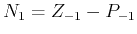
Z-1 = number of zeros of 1+ GH(z) outside the unit circle in the z -plane.
P-1 = number of poles of 1+ GH(z) outside the unit circle in the z -plane.
P0 = number of poles of GH(z) (same as number of poles of 1+ GH(z)) that are on the unit circle.
N1 = number of times the (-1, j0) point is encircled by the Nyquist plot of GH(z) corresponding to z1 .
N2 = number of times (-1, j0) point is encircled by Nyquist plot of GH(z) corresponding to z2.
According to the principle of argument in complex variable theory