Taking derivative of the above function with respect to u(k),
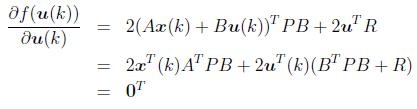
The matrix  is positive definite since R is positive definite, thus it is invertible. Hence,

where  . Let us denote by S. Thus

We will now check whether or not u* satisfies the second order sufficient condition for minimization. Since

u* satisfies the second order sufficient condition to minimize f.
The optimal controller can thus be constructed if an appropriate Lyapunov matrix P is found. For that let us first find the closed loop system after introduction of the optimal controller.

Since the controller satisfies the hypothesis of the theorem, discussed in the previous lecture,

Putting the expression of u* in the above equation,
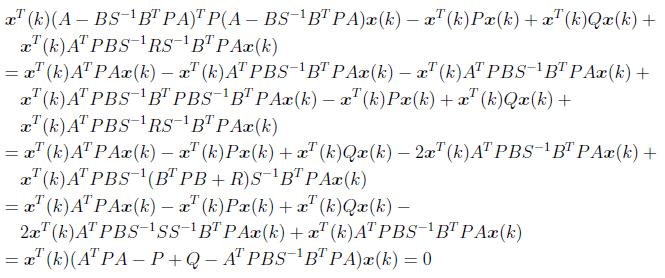
The above equation should hold for any value of x(k). Thus

which is the well known discrete Algebraic Riccati Equation (ARE). By solving this equation we can get P to form the optimal regulator to minimize a given quadratic performance index.