1 Linear Quadratic Regulator
Consider a linear system modeled by

where  and
and  . The pair
  is controllable.
The objective is to design a stabilizing linear state feedback controller 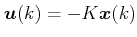 which will minimize the quadratic performance index, given by,
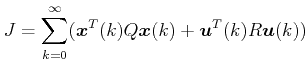
where, 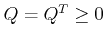 and
and 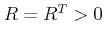 . Such a controller is denoted by u*.
We first assume that a linear state feedback optimal controller exists such that the closed loop system

is asymptotically stable.
This assumption implies that there exists a Lyapunov function  for the closed loop system, for which the forward difference

is negative definite.
We will now use the theorem as discussed in the previous lecture which says if the controller u* is optimal, then

Now, finding an optimal controller implies that we have to find an appropriate Lyapunov function which is then used to construct the optimal controller.
Let us first find the u* that minimizes the function

If we substitute  in the above expression, we get
