Equation (5) is known as the discrete Euler-Lagrange equation and equation (6) is called the transversality condition which is nothing but the boundary condition needed to solve equation (5).
Discrete Euler-Lagrange equation is the necessary condition that must be satisfied for Ja to be an extremal.
With reference to the additional conditions (2) and (3), for arbitrary  and
and  ,
,
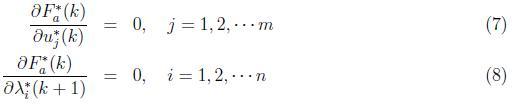
Equation (8) leads to

which means that the state equation should satisfy the optimal trajectory. Equation (7) gives the optimal control  in terms of
In a variety of the design problems, the initial state x(0) is given. Thus η (0) = 0 since x(0) is fixed. Hence the tranversality condition reduces to
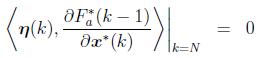
Again, a number of optimal control problems are classified according to the final conditions.
If x(N) is given and fixed, the problem is known as fixed-endpoint design. On the other hand, if x(N) is free, the problem is called a free endpoint design.
For fixed endpoint (x(N) = fixed, η (N) = 0 ) problems, no transversality condition is required to solve.
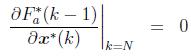
For free endpoint the transversality condition is given as follows.
For more details, one can consult Digital Control Systems by B. C. Kuo.