Calculus of variation says that the minimization of J with constraint is equivalent to the minimization of Ja without any constraint.
Let  and
and  represent the vectors corresponding to optimal trajectories. Thus one can write
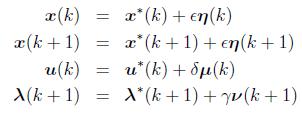
where 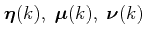 are arbitrary vectors and
  are small constants.
Substituting the above four equations in the expression of Ja,

To simplify the notation, let us denote Ja as
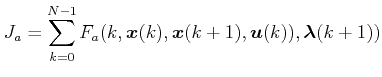

Expanding Fa using Taylor series around and , we get
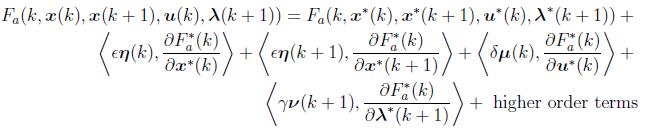
where

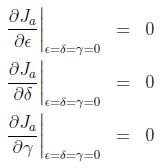
The necessary condition for Ja to be minimum is