Mathematical description of sequence components (contd..)
10.3.2
Significance of Transformation
One should understand the significance of linearity in sequence component transformation clearly.
Sequence transformation matrix [T] provides a methodology to convert sequence domain phasors to phase domain
phasors.
Conversely, inverse transformation matrix [T -1] provides a mechanism to convert phasors in a-b-c domain to sequence
domain. This is typically required for analysis purpose. Also, the mapping between phase domain and sequence domain is 1:1.
There is no loss of information in either domain. In other words, both domains have identical information content.
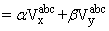
The transformations [T] and [T-1 ] are linear i.e. if and are two sets of three phase phasors in a-b-c domain,
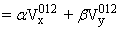
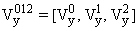
then superposition and in phase domain is equivalent to corresponding superposition in sequence domain. Conversely, if we superpose phasors in sequence domain, then in a-b-c domain also it amounts to equivalent superposition of phasors. Thus,
Where , and
and
are complex numbers.
Similarly,
Sequence components provide a methodology to view unbalanced phasors as a set of balanced phasors. If a network is balanced, then the resulting analysis gets extremely simplified. This is because we are able to break a three phase network into three decoupled sequence networks (under some acceptable symmetry assumptions). We now elaborate on this concept of decoupled sequence networks.


 and
 are two sets of three phase phasors in a-b-c domain,

 ,
 and
 are complex numbers.