It represents a set of balanced phasors
,
and
. If we choose 'a' phase as reference phasor.
(1)
(2)
Where
‘a' is cubic root of unity. Multiplying a phasor by ‘a' causes a rotation of
in the anticlockwise direction (lead of ). Similar usage of a2 results in
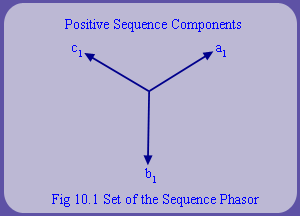
in the anticlockwise direction or equivalently a lag of . The positive sequence of phasors is the same balanced set of phasors that we expect in steady operation of an ideal power system. Thus, a, b and c phasors are nothing but Va1, Vb1 and Vc1 respectively. The sequence phasors are shown in fig 10.1. If the stator of an induction motor is subjected to positive sequence voltage, it should cause rotation in anticlockwise direction. Note that placement of Va1 can be done arbitrarily in the x-y plane. But once, Va1 is fixed both Vb1 and Vc1 are fixed.
Thus, a positive sequence set of phasors have 2 degrees of freedom i.e. we can decide placement of |Va1| (magnitude) and arbitrarily.

 ,
 and
 . If we choose 'a' phase as reference phasor.


 in the anticlockwise direction (lead of
 in the anticlockwise direction or equivalently a lag of
 arbitrarily.

