| 10.4 |
Modeling Network in Sequence Components (contd..) |
| |
Let Z0 = Zs + 2Zm
Z1 =Zs - Zm
Z2 = Zs - Zm
Then equation (8) can be decoupled into three separate equations one for each sequence component as follows.
 ,  and 
Also, note that
 ,  and  are the eigen values of the phase-impedance matrix  . Reference phasor subscript 'a' has been dropped for convenience.
Thus, we see that positive, negative and zero sequence networks are decoupled. In general, if Z matrix has following circulant symmetry we can decouple the positive, negative and zero sequence networks by sequence transformation T. It can be shown that if,
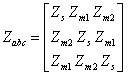 , then 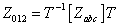 |
| |
where 
 
 |
(10) |
| |
Thus, all the sequence components can be determined from the above equations. |
| 10.4.1 |
Advantages of Sequence Transformation |
 |
It is used when the network is balanced. For a n - node system a  linear system solver 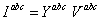 can |
| |
be decoupled into three  linear system solvers,  and  . Hence it provides decoupling of the network. |
|
It can be applied for both balanced and unbalanced loads. However, simplicity and elegance of sequence component |
| |
approach reduces when network is unbalanced. |
|
Zero sequence current is used to provide sensitive earth fault detection technique. |
| |
|


