| 10.3 |
Mathematical description of sequence components |
| |
So far we have seen that,
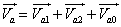
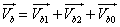
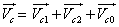
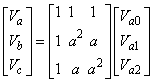
Using equation (1) to (5), we get |
| |
|
 |
(6) |
| |
or stated more compactly,
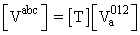 where  and  |
| |
Matrix [T] defines a linear transformation of phasors from sequence domain to phase domain. Matrix [T] enjoys some interesting properties. For example, every pair of rows or columns of matrix [T] are orthogonal. For example, |
| |
If c1 = (1, 1, 1) t and c2 = (1, a2, a)t
Then, (c1)H c2 = (c2)H c1 = 0 where H is Hermitian operator defined as transpose and conjugate of a vector or matrix.
Similarly,
In other words, TH T = T TH = D, where D is a diagonal matrix |
| |
With  |
| |
It can be verified that |
| |
|
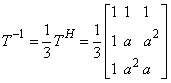 |
|
| |
and |
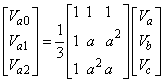 |
(7) |
| |
|
|


