Lemma: If AKS algorithm return PRIME then n is prime.
Proof: Assume that the algorithm return prime. Recall that  and is generated by n and p, therefore t≥ Or(n) > log2 (n) or
 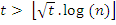 .
.
We know that 
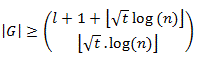
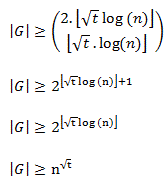
Also by lemma,  if p is not a power of p. Therefore it must be the case that n= pk for some k>0 . But STEP 1 did not output COMPOSIT, so k=1, proving that n is indeed prime. This completes our proof of theorem .
Time Complexity:
The overall complexity of AKS algorithm is O (log10.5(n)).
Conclusion: In this report we have presented the three important Primality testing algorithms, Miller- Rabin Test, Solovay –Strassen test, AKS algorithm. We also gave an introduction to the Jacobi symbol. The AKS algorithm is an unconditional deterministic polynomial time algorithm for Primality testing. It was first of its kind. The algorithm was a major breakthrough for Primality testing and in general for mathematics. The authors received many accolades, including the 2006 Godel prize and the 2006 Fulkerson Prize, for this work.
References:
1. R. Motwani and P. Raghavan, Randomized algorithms. Cambridge University Press,1995.
2. M. Agarwal, N.Kayal and N.saxena , primes in P,Department of Computer Science Engineering, Indian Institute of technology Kanpur. Available from the World wide web http:// www.cse.iitk.ac.in/news/primality.pdf
3. Trappen and Washington, Introduction to Cryptography with Coding Theory.
4. G.L. Miller riemanns hypothesis and tests for Primality.
5. M.O. Rabin . Probabilistic algorithm for testing primality.
Acknowledgement: Mr. Sai Sheshank Burra (B. Tech, CSE) [Scribe for Last Three Lectures]