Lemma : 
Proof: Note that because h(x) is a factor of Qr(X) , x is a primitive rth root of unity in F. We now show that if f, g ∈ P are distinct polynomials with degrees less than t, then they map to distinct elements in G.
Suppose, that f(x) =g(x) in F. Let m ∈ I. Then m is introspective for f and g, so f(xm)=g(xm) within F. Then xm is a root of j(z)=f(z)-g(z) for every m ∈ Ir. We know,(m,r)=1, so each such xm is a primitive rth root of unity. Hence there are  distinct roots of j(z) in F. But the degree j(z) < t by the choice of f and g. This contradiction ( a polynomial cannot have more roots ina field than its degree) implies that f(x)≠ g(x) in F.
Notice that i≠ j in Fp whenever 1≤ i, j≤ l since  Then by above ,x,x+1,x+2,x+3...x+l are a. Since the degree of h(x) is greater than 1, all of these linear polynomials are nonzero in F. therefore there are atleast, l+1 distinct polynomials of degree 1 in G. hence there atleast
  polynomials of degree s in G. Then the order of G is atleast
  . hence the proof.
Lemma : If n is not a power of p then  .
.
Proof: Consider the following subset of I:
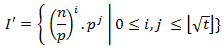
If n is not a power of p, then  Since
Since  there are at least two elements of I’ that are equivalent modulo r. Label these elements m1,m2 where m1>m2 .
Then 
Let f(x)∈P Then because m1,m2 are introspective

Thus 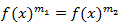 in the field F. Therefore the polynomial
  has atleast |G| roots in F (since f(x) ∈ P was arbitrary). Then because
 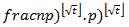 is the largest element of I’.

It follows that . Hence the proof.