Algorithm:
INPUT: n ≥ 1
STEP 1: If ∃ a, b > 1∈ N such that n= ab, then output COMPOSITE.
STEP2: Find the minimal r ∈ N such that or(n) > log2 (n)
STEP3 : For a=1to r do
If 1< (a,n) < n, then output COMPOSITE
STEP4: if r ≥ n, then output PRIME
STEP5: For a=1 to 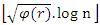 do
do
If (x+a)n – (xn +a) ≠ 0 mod (n, xr -1), then output COMPOSITE.
STEP 6: output PRIME.
Proof: If n is prime, STEP 1 cannot return COMPOSITE. Similarly, STEP 3 cannot return COMPOSITE. Hence, the AKS algorithm will always return PRIME if n is prime.
Conversely, if the AKS algorithm returns PRIME, we will prove that n is indeed prime. If the algorithm returns PRIME in STEP 4, n must be prime because otherwise a non trivial factor a would have been found in STEP 3. The only case which remains is that if the algorithm returns PRIME in STEP 6.
Lemma: There exists an integer r ∈ N with the following properties:
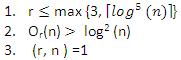
Proof:
For n=2, r=3 satisfies all the conditions.
For 
We know that for n ≥ 7, lcm(n) ≥ 2n where lcm(m) denote the LCM of first m numbers.