| Analysis of dowel bar
Analysis
Recall the formulation developed as Equation
13 , in the lecture on 'analysis
of concrete pavement' , representing beam on elastic
foundation. By putting appropriate boundary conditions
to that equation, for a semi-infinite beam with a moment, Mo,
and a point load, P, the following solution
emerges for Winker's foundation (Porter
2001, Timoshenko
and Lessels 1925 ):
 |
(25) |
where,
y = the deflection along the x direction,  , and is called as the relative stiffness of the beam on the elastic foundation, k = spring constant, E = elastic modulus of the beam and I = moment of inertia of the beam section. , and is called as the relative stiffness of the beam on the elastic foundation, k = spring constant, E = elastic modulus of the beam and I = moment of inertia of the beam section.
From Equation 1, the deflection of the
dowel bar at the face of the joint, yo, can
be obtained as (Friberg
1940):
 |
(26) |
where, 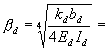 relative stiffness of the dowel bar resting on concrete (assumed as elastic foundation), kd = modulus of dowel support, bd = dowel bar width (i.e. diameter), Ed = elastic modulus of the dowel bar, Id = moment of inertia of the dowel bar, Pd = load transferred through the dowel bar and z =joint width. relative stiffness of the dowel bar resting on concrete (assumed as elastic foundation), kd = modulus of dowel support, bd = dowel bar width (i.e. diameter), Ed = elastic modulus of the dowel bar, Id = moment of inertia of the dowel bar, Pd = load transferred through the dowel bar and z =joint width.
Though the above equation assumes dowel bar
to be semi-infinite, Porter
(2001) showed that Equation (26) gives a reasonably good
estimate of deflection obtained from more rigorous analysis.
Thus, the bearing stress developed, σbd,
can be expressed as the product of modulus of dowel support
( kd) and the deflection at the face of joint
( yo) (Porter
2001), i.e.
 |
(27) |
For a successful dowel bar design, the value
of σbd needs to be kept
lower than the allowable bearing stress of concrete, σbd,
specified as (ACI 1956, Porter
2001, IRC:58 2002):
 |
(28) |
where, σbd is expressed in MPa, fck = characteristic compressive strength of concrete in MPa and bd is the diameter (i.e. width) of the dowel bar in mm,
Joint load transfer efficiency
Ideally, the dowel bar system should be able to transfer the whole load applied to it. However, voids developed due to repetitive loading reduce the joint load transfer efficiency ( JLTE ) of the dowel bar. The JLTE (expressed in percentage) of a dowel bar can be defined as (Porter 2001, Ioannides and Korovesis 1992 )

where, Pa is
the load applied to the dowel bar. The force transmitted
being somewhat difficult to measure, joint
load transfer efficiency is sometimes
measured in terms ratio of deflections. If impact loading
(generally, falling weight deflectometer ( FWD )
is used for this purpose) is applied near the transverse
dowelled joint of a slab, the JLTE can be defined
as the percentage of the deflection of the unloaded slab
with reference to the deflection of the loaded slab. Figure
1 schematically shows two extreme situations as JLTE =
0% and JLTE = 100%. Various researches and documents
(Porter 2001, Yoder
and Witczak 1975, ACPA
1991 ) suggest that the load transfer efficiency varies
between 35 to 50%.
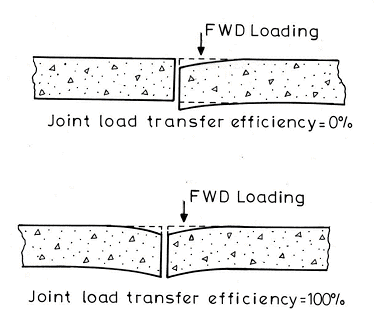
Figue-21 Schematic diagram explaining
the deflection based load transfer efficiency (Chakroborty
and Das 2003)
Distribution of load
A part of the load applied is shared by the
dowel bar system. Essentially, this load is not shared by
only one dowel bar, rather, it is shared by a group of dowel
bars. (These dowel bars are placed at some designed interval).
Thus, it is important to know (i) how many dowel bars participate
in load transfer, and (ii) how is this load shared across
the various participating dowel bars.
Fridberg (1940) suggested that a length of up to 1.8 × radius of relative stiffness (refer to Equation (11) of the lecture 'analysis of concrete pavement' for definition) participate in the load transfer. It is also suggested that the load may be taken as linearly varying with maximum share taken by the dowel bar which is just vertically below the wheel. Tabatabaie et al. (Porter 2001) suggested that instead of taking the factor as 1.8 it should be taken as 1.0 .
From design point of view, the wheel can be placed in two ways over the transverse edge of the slab, viz. case (i) the wheel at one edge or, case (ii) the wheel is at the middle. Obviously, the maximum load shared by a dowel bar in case (i) will be more than case (ii) . Hence case (i) would govern the design of dowel bar.
|


