| Design of dowel bar
By the term design
of dowel bar , it is meant to estimate the dowel
bar diameter and spacing. One of them can be assumed
as known or fixed, and the other is estimated. Dowel
bars are generally designed from two considerations:
(i) Bearing stress approach, where the developed bearing
stress is set equal to or less than the allowable bearing
stress, and (ii) Relative deflection approach, where
the relative deflection of the joints is not allowed
to exceed some maximum specified value.
Example design
An example on design of dowel bar system from bearing stress consideration is presented in the following.
Problem
A design wheel load of 65kN
is applied on to the concrete pavement slab, and 50% of the
load is assumed to be transmitted through the dowel bar system.
Assume the characteristic compressive strength (fck)
of concrete (used in the concrete pavement) is 40MPa, the transverse
joint width ( z ) is 15 mm, radius of relative stiffness
(l) of the concrete slab as 950mm, Elastic modulus
of steel (E) as 2.0 x 10⁵ N/mm2 and modulus of
dowel support (kd) as 415N/mm 3 . Design the dowel
bar system.
Solution
Assume, 32mm diameter dowel bars are used.
The allowable bearing stress (σba )
can be obtained from Equation (28) as:
 = 29.23 MPa = 29.23 MPa
Assume, dowel bar spacing as 300 mm center-to-center. Thus, in 950 mm of effective length (using Tabatabaie et al. criterion) , 4 dowel bars can be placed.
Assuming, the load carried by the dowel bar which is just below the wheel, is Pd, one can write the load distribution equation of the dowel bar system as:

or, Pd=15437.5 N
Now,
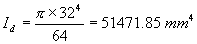
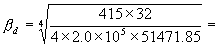 0.0238 per mm 0.0238 per mm
From Equation (27), the developed bearing
stress in dowel bar
 = =  N/mm2 =
27.20 MPa N/mm2 =
27.20 MPa
It is noted that  < <  , thus the design is safe. Thus, dowel bar of 32 mm may be provided with 300mm center-to-center. , thus the design is safe. Thus, dowel bar of 32 mm may be provided with 300mm center-to-center.
|


