Delay and queue analysis at signalized intersections
In this section the delay faced by vehicles at signalized intersections and the queues developed at signalized intersections are studied. Consider the plot shown in Figure 7. In this figure, the abscissa is time and the ordinate is the cumulative number of arrivals as well as the cumulative number of departures for a given stream (or approach) at an intersection. There are two lines in the figure. One shows a typical graph for cumulative number of arrivals on the given approach at a signalized intersection, the other shows the cumulative number of departures from the given approach at the signalized intersection. On the abscissa, the time is divided into slots named Cycle I, Cycle II, and so on. These slots represent the cycles at the intersection. Each cycle is further subdivided into R and G. The R represents the duration of effective red (i.e., the time during which no vehicle on this particular approach crosses the intersection); similarly the G represents the duration of effective green (i.e., the time during which vehicles on this particular approach crosses the intersection).
Fig. 7: A typical plot of cumulative number of arrivals and departures on an approach to a signalized intersection.
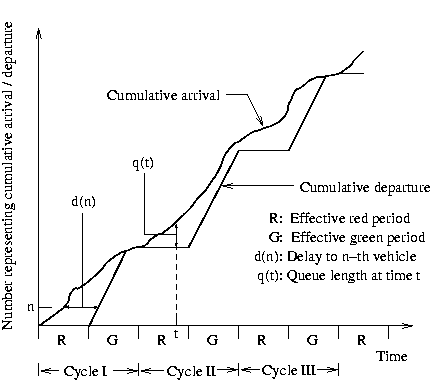 |
Figure 7 gives a reasonably complete picture of the arrival and departure processes at the intersection. From such a plot, we can obtain information about both delay and queues. The horizontal distance at a value of n on the ordinate, for example, will give the delay faced by the nth vehicle to arrive at the intersection. Hence summing all such horizontal distances (or equivalently the area between the two lines) will give the total delay faced by all the vehicles arriving at the intersection. The total delay divided by the total number of arrivals will provide the average delay.
Similarly, the queues on the approach can be easily determined from this figure. For example, the vertical distance between the two lines at time t will give the queue length at the intersection approach at time t. This implies that the queue lengths at any given time can be obtained easily from the figure and hence the parameters such as average queue length, variance of queue lengths, and the like can also be obtained.
However, obtaining such graphs for each and every intersection at all times is not feasible. Hence it is imperative that we analyze the delay to vehicles and queues with an aim to derive equations which can give these quantities once data on arrival rates, cycle lengths, green times, red times, etc. are known. In the following, such a description of the analyses procedures is provided.
|


