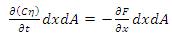
As per the law of conservation of mass, net flux is equal to the rate of change in flux in time dt
 (31.20)
Here, CηdxdA is the total volume of solute in the control volume
Putting, 
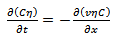 (31.21)
 [Considering η is a constant, i.e. the aquifer is homogeneous] (31.22)
This is the one dimensional advection transport equation.
Mechanical dispersion
In the case of flow through porous media, the solute containing water is not moving at the same velocity as that of water. As a result additional mixing is occurred along the flow path. This additional mixing is called mechanical dispersion. It may be noted that the mixing that occurs along the direction of flow path is called longitudinal dispersion. On the other hand, the mixing that occurs normal to the flow path is called transverse dispersion.
If it is assumed that the phenomenon of mechanical dispersion can be explained by Fick's law, then a coefficient of mechanical dispersion can be introduced. In this case, the coefficient of mechanical dispersion is a function of the average linear velocity. The amount of dispersion in longitudinal direction and transverse direction is different. Therefore, the coefficient in longitudinal direction is called coefficient of longitudinal mechanical dispersion (αLvL) and that in the transverse direction is called coefficient of transverse mechanical dispersion (αTvL). Where vL is the average linear velocity in the longitudinal direction (L/T), αL is the dynamic dispersivity in the longitudinal direction (L) and αT is the dynamic dispersivity in the transverse direction (L).
Hydrodynamic Dispersion
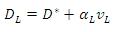
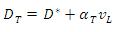
In case of flow through porous media, the molecular diffusion process and mechanical dispersion process are difficult to separate. As such, these two processes are combined by a single parameter called hydrodynamic dispersion coefficient which can be expressed as,
 (31.23)
 (31.24)
Where DL is the longitudinal hydrodynamic dispersion and DT is the transverse hydrodynamic dispersion