Effective diffusion coefficient
In case of flow through porous media, the dispersion process of solute is not as fast as in water because the solute ions have to follow longer pathways when they move through the tortuous path of the porous matrix. As such, an effective diffusion coefficient has to be used to account this phenomenon. The effective diffusion coefficient is defined as ,
 (31.14)
Where, ω is a coefficient that is related to the tortuosity of the porous matrix. The value of ω is always less than 1 and can be obtained using laboratory study. Freeze and Cherry (1979), based on their experimental studies suggested that ω is in between 0.5 and 0.01. Perkins and Johnson (1963) did a sand column study and found that ω is around 0.7 for sand.
Advection process
Advection is a process by which the dissolved solids are transported with the flowing groundwater. The amount of solute transported by the advection process is a function of quantity of groundwater flowing and the concentration of solute in the groundwater. If v is the average linear velocity of water in porous matrix, C is the concentration of solute in groundwater and η is the effective porosity of the porous matrix, the one dimensional mass flux due to advection will be,
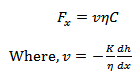 (31.15)
and η is the effective porosity which is the porosity through which flow can actually occur.
Consider the control volume shown in Fig. 31.3 below
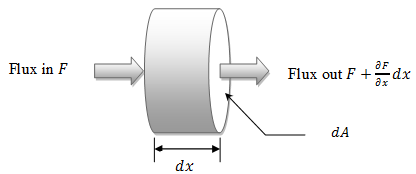
- Fig 31.3 One dimensional control volume
Flux in to the control volume is
FdA (31.16)
Flux out from the control volume is
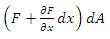 (31.17)
Net Flux = Flux in – Flux out
= 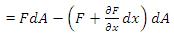 (31.18)
=  dA (31.19)