At the tangent point, radius is infinity and hence centrifugal acceleration is
zero.
At the end of the transition, the radius R has minimum value R.
The rate of change of centrifugal acceleration should be adopted such that the
design should not cause discomfort to the drivers.
If is the rate of change of centrifugal acceleration, it can be written as:
Therefore, the length of the transition curve in is
(1)
where is the rate of change of centrifugal acceleration given by an
empirical formula suggested by by IRC as below:
Raise () of the outer edge with respect to inner edge is given by
.
The rate of change of this raise from to is achieved gradually with a
gradient of in over the length of the transition curve (typical range
of is 60-150).
Therefore, the length of the transition curve is:


 is the rate of change of centrifugal acceleration, it can be written as:


 in
in  is
is





 ) of the outer edge with respect to inner edge is given by
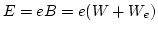 .
The rate of change of this raise from
.
The rate of change of this raise from  to
to  in
in  over the length of the transition curve (typical range
of
over the length of the transition curve (typical range
of  is:
is:
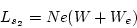


 as:
as:

 is the maximum of
equations
is the maximum of
equations 