|
The trip pattern in a study area can be represented by means of a trip matrix
or origin-destination (O-D)matrix.
This is a two dimensional array of cells where rows and columns represent each
of the zones in the study area.
The notation of the trip matrix is given in figure 1.
Figure 1:
Notation of a trip matrix
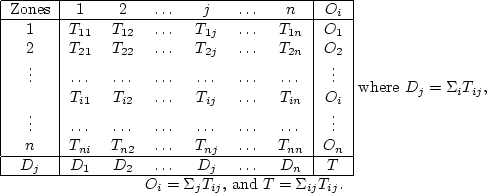 |
The cells of each row  contain the trips originating in that zone which have
as destinations the zones in the corresponding columns. contain the trips originating in that zone which have
as destinations the zones in the corresponding columns.
 is the number of trips between origin and destination is the number of trips between origin and destination  . .
 is the total number of trips between originating in zone and is the total number of trips between originating in zone and  is
the total number of trips attracted to zone .
The sum of the trips in a row should be equal to the total number of trips
emanating from that zone.
The sum of the trips in a column is the number of trips attracted to that zone.
These two constraints can be represented as: is
the total number of trips attracted to zone .
The sum of the trips in a row should be equal to the total number of trips
emanating from that zone.
The sum of the trips in a column is the number of trips attracted to that zone.
These two constraints can be represented as:

 If reliable information is available to estimate both and , the
model is said to be doubly constrained.
In some cases, there will be information about only one of these constraints,
the model is called singly constrained.
If reliable information is available to estimate both and , the
model is said to be doubly constrained.
In some cases, there will be information about only one of these constraints,
the model is called singly constrained.
|

