|
This model originally generated from an analogy with Newton's gravitational
law.
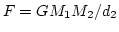
Newton's gravitational law says,
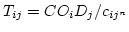
 Analogous to this,
 Introducing some balancing factors,
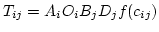 where
where  and and  are the balancing factors, are the balancing factors,  is the generalized
function of the travel cost.
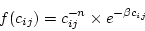
This function is called deterrence function because it represents the
disincentive to travel as distance (time) or cost increases.
Some of the versions of this function are: is the generalized
function of the travel cost.
This function is called deterrence function because it represents the
disincentive to travel as distance (time) or cost increases.
Some of the versions of this function are:
 |
(1) |
 |
(2) |
 |
(3) |
The first equation is called the exponential function, second one is called
power function where as the third one is a combination of exponential and power
function.
The general form of these functions for different values of their parameters is
as shown in figure.
As in the growth factor model, here also we have singly and doubly constrained
models.
The expression
is the classical version of
the doubly constrained model.
Singly constrained versions can be produced by making one set of balancing
factors or equal to one.
Therefore we can treat singly constrained model as a special case which can be
derived from doubly constrained models.
Hence we will limit our discussion to doubly constrained models.
As seen earlier, the model has the functional form,
 |
(4) |
But
 |
(5) |
Therefore,
 |
(6) |
From this we can find the balancing factor as
 |
(7) |
depends on which can be found out by the following equation:
 |
(8) |
We can see that both and are interdependent.
Therefore, through some iteration procedure similar to that of Furness method,
the problem can be solved.
The procedure is discussed below:
- Set = 1, find using equation 8
- Find using equation 7
- Compute the error as
 where
where  corresponds to the actual productions from zone corresponds to the actual productions from zone  and and  is
the calculated productions from that zone. Similarly is
the calculated productions from that zone. Similarly  are the actual
attractions from the zone are the actual
attractions from the zone  and and  are the calculated attractions from
that zone. are the calculated attractions from
that zone.
- Again set = 1 and find , also find . Repeat these steps
until the convergence is achieved.
|

