This is the principle of complimentary virtual work and used for computing displacements.
Consider a structure shown in Figure 4.12(a) and subjected to P force and it is required to find the displacement of point C in the direction specified. First apply a virtual force  at C in the required direction. Next apply the external (real) loads acting on the structures as shown in Figure 4.12(a) with the virtual force remain in the position. The displacement of C in the required ditection be at C in the required direction. Next apply the external (real) loads acting on the structures as shown in Figure 4.12(a) with the virtual force remain in the position. The displacement of C in the required ditection be  and the internal elements deform by an amount and the internal elements deform by an amount  . Using Eq. (4.10) . Using Eq. (4.10) |

 … referred as P force) under stable equilibrium condition as shown in Figure 4.11(a). Further, consider a small element within the structural system and stresses on the surfaces caused by the P forces are shown in Figure 4.11(b) and referred as
  .
. 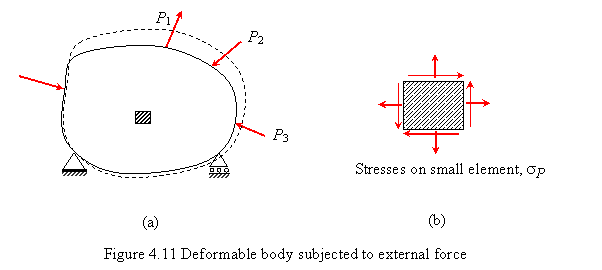
 . These displacements are imaginary and fictitious as shown by dotted line. While the body is displaced, the real forces acting on the body move through these displacements. These forces and virtual displacements must satisfy the principle of conservation of energy i.e.

 ).
). 

 moving through the real dispolacement
  . On the other hand, the right hand side of Eq. (4.11) represents the internal work done by the virtual internal element forces d f moving through the displacement
  .
.  is arbitrary and for convenience let
  =1 (i.e. unit load). The Eq. (4.11) can be re-written as