| |
Recall the Eq. (4.15) in which the bending deflection of the beams and frames are obtained by the integration of the two bending moments variations (i.e.  and and  ) over a length of the members. However, for a uniform beam section (i.e. EI is constant) such integrals can be readily derived depending upon the various shapes of the bending moment diagrams. The computation of integral ) over a length of the members. However, for a uniform beam section (i.e. EI is constant) such integrals can be readily derived depending upon the various shapes of the bending moment diagrams. The computation of integral  is given in the Table 4.A1. The various steps for this method for finding deflections of the beams and frame are: is given in the Table 4.A1. The various steps for this method for finding deflections of the beams and frame are: |
| |
- Draw the bending moment diagram of given beam or frame due to applied external loading (i.e.
 diagram). diagram).
- Draw the corresponding bending moment diagram due to unit load applied in the direction of interested deflection (i.e.
 diagram). diagram).
- Compute the desired deflection by computing the
 with the help of results shown in Table 4.A1. with the help of results shown in Table 4.A1.
|
| |
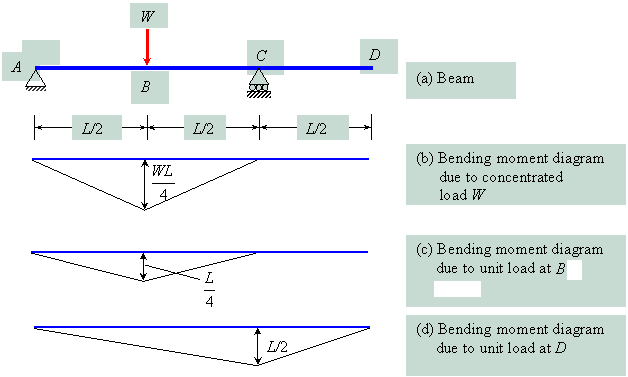
Example 4.15 Determine the deflection under the load and point D of a simply supported beam with overhang as shown in Figure 4.21
|
| |
Solution: Bending moment diagram (i.e.
 diagram) due to concentrated load W is shown in Figure 4.21(b). diagram) due to concentrated load W is shown in Figure 4.21(b). |
| |
Deflection under the Load : Apply a vertical unit load in place of W . The bending moment diagram due to this load is shown in Figure 4.21(c). The vertical deflection under the load is obtained by multiplying the bending moment diagrams of Figure 4.21(b) and (c) and is given by |
| |
Deflection of the free end : Apply a unit vertical load acting upward at point D of the beam. The bending moment diagram due to this load is shown in Figure 4.21(d). The vertical deflection under the load is obtained by multiplying the bending moments diagrams of Figure 4.21(b) and (d) and is given by |