| |
| | |
|
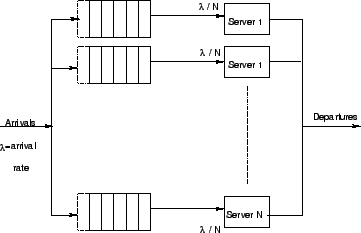
In this model there are N numbers of identical independent parallel servers
which receive customers from a same source but in different parallel queues
(Compare to M/M/N model.
It has only one queue) each one receiving customers at a rate of
 .
Fig. 1 shows how a typical multiple single servers'
model looks like. .
Fig. 1 shows how a typical multiple single servers'
model looks like.
Figure 1:
Multiple single server
 |
Consider the problem 1 as a multiple single server's model with two servers
which work independently with each one receiving half the arrival rate that is
150 vehicles/hr.
Mean arrival rate =  = 150 vehicles/hr.
Mean service rate = = 150 vehicles/hr.
Mean service rate =
 vehicles/hr.
Utilization factor = traffic intensity = vehicles/hr.
Utilization factor = traffic intensity =
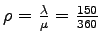 = 0.416.
The percent of time the toll booth will be idle = P(0) = P(X=0) = = 0.416.
The percent of time the toll booth will be idle = P(0) = P(X=0) =
 =35.04 min.
The average number of vehicles in the system = =35.04 min.
The average number of vehicles in the system =
![$ E[X]=\frac{\rho}{1-\rho}$](img7.png) =
0.712.
The average number of vehicles in the queue = =
0.712.
The average number of vehicles in the queue =
 =
0.296.
The average a vehicle spend in the system = =
0.296.
The average a vehicle spend in the system =
![$ E[T]= W =\frac{1}{\mu-\lambda}$](img9.png) =
0.0047 hr = 0.285 min = 17.14 sec.
The average time a vehicle spends in the queue = =
0.0047 hr = 0.285 min = 17.14 sec.
The average time a vehicle spends in the queue =
![$ E[T_q] = W_q
=\frac{\lambda}{\mu(\mu-\lambda)}$](img10.png) = 0.0022hr = 0.13 min = 8.05 sec = 0.0022hr = 0.13 min = 8.05 sec
| |
M/M/1 model |
M/M/2 model |
Multiple single |
| |
|
|
server model |
| Idle time of toll |
8.34 |
55.2 |
35.04 |
| booths(minutes) |
|
|
|
| Number of vehicles |
4.98 |
1.22 |
0.712 |
| in the system(units) |
|
|
|
| Number of vehicles |
4.01 |
0.387 |
0.296 |
| in the queue(units) |
|
|
|
| Average waiting time |
57.6 |
14 |
17.14 |
| in system(seconds) |
|
|
|
| Average waiting time |
50 |
4.64 |
8.05 |
| in queue(seconds) |
|
|
|
From the Table 1 by providing 2 servers the queue length reduced from 4.01 to
0.387 and the average waiting time of the vehicles came down from 50 sec to
4.64 sec, but at the expense of having either one or both of the toll booths
idle 92% of the time as compared to 13.9% of the time for the single-server
situation.
Thus there exists a trade-off between the customers' convenience and the cost
of running the system.
|
|
| | |
|
|
|


