There are various kinds of queuing models.
These queuing models have a set of defined characteristics like some arrival
and service distribution, queue discipline, etc.
The queuing models are represented by using a notation which is discussed in
the following section of queue notation.
In this model the arrival times and service rates follow Markovian distribution
or exponential distribution which are probabilistic distributions, so this is
an example of stochastic process.
In this model there is only one server.
The important results of this model are:
Vehicles arrive at a toll booth at an average rate of 300 per hour.
Average waiting time at the toll booth is 10s per vehicle.
If both arrivals and departures are exponentially distributed, what is the
average number of vehicles in the system, average queue length, the average
delay per vehicle, the average time a vehicle is in the system?
Mean arrival rate = 300 vehicles/hr.
Mean service rate
vehicles/hr.
Utilization factor = traffic intensity =
= 0.833.
Percent of time the toll booth will be idle = P(0) = P(X=0) =
=8.34 min.
Average number of vehicles in the system =
=4.98.
Average number of vehicles in the queue =
=
4.01.
Average a vehicle spend in the system =
=
0.016 hr = 0.96 min = 57.6 sec.
Average time a vehicle spends in the queue =
= 0.013hr = 0.83 min = 50 sec.




 = 300 vehicles/hr.
Mean service rate
= 300 vehicles/hr.
Mean service rate
 vehicles/hr.
Utilization factor = traffic intensity =
vehicles/hr.
Utilization factor = traffic intensity =
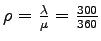 = 0.833.
Percent of time the toll booth will be idle = P(0) = P(X=0) =
= 0.833.
Percent of time the toll booth will be idle = P(0) = P(X=0) =
 =8.34 min.
Average number of vehicles in the system =
=8.34 min.
Average number of vehicles in the system =
![$ E[X]=\frac{\rho}{1-\rho}$](img9.png) =4.98.
Average number of vehicles in the queue =
=4.98.
Average number of vehicles in the queue =
![$ E[L_q] = \frac{\rho^2}{1-\rho}$](img10.png) =
4.01.
Average a vehicle spend in the system =
=
4.01.
Average a vehicle spend in the system =
![$ E[T] = \frac{1}{\mu-\lambda}$](img11.png) =
0.016 hr = 0.96 min = 57.6 sec.
Average time a vehicle spends in the queue =
=
0.016 hr = 0.96 min = 57.6 sec.
Average time a vehicle spends in the queue =
![$ E[T_q] =
\frac{\lambda}{\mu(\mu-\lambda)}$](img12.png) = 0.013hr = 0.83 min = 50 sec.
= 0.013hr = 0.83 min = 50 sec.