| |
| | |
|
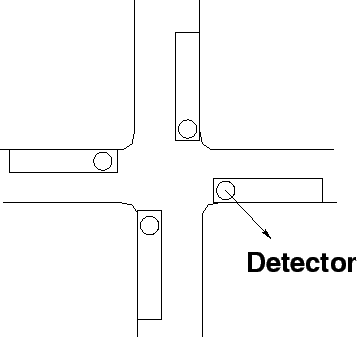
- Detectors on all approaches.
- Each phase has a preset initial interval.
- Phases are sequenced according to "calls" for service on all approaches.
- Green interval is extended by a preset unit extension for each actuation
after the initial interval provided a gap greater than the unit extension does
not occur.
- Green extension is limited by preset maximum limit.
- Generally Point Detectors are used.
- Detectors can be placed at either stop line or upstream location.
Figure 1:
Full-Actuated Control
 |
- Reduces delay relative to pre-timed control by being highly responsive
to traffic demand and to changes in traffic pattern.
- Detection information allows the cycle time to be efficiently allocated
on a cycle-by-cycle basis.
- Allows phases to be skipped if there is no call for service, thereby
allowing the controller to reallocate the unused time to a subsequent phase.
- Initial and maintenance cost is higher than that of other control types
due to the amount of detection required.
- It may also result in higher percentage of vehicles stopping because
green time is not held for upstream platoons.
Volume-Density Controllers are designed for intersections of major traffic
flows having considerable unpredictable fluctuations.
They are generally used at intersections with high approach speeds ( 45
mi/hr).
Here, detectors are placed on all approaches.
Generally this type of controller is used with Area Detectors.
To operate efficiently, this type of control needs to receive traffic
information early enough to react to existing conditions.
So, it is essential that detectors be placed far in advance of the
intersection. 45
mi/hr).
Here, detectors are placed on all approaches.
Generally this type of controller is used with Area Detectors.
To operate efficiently, this type of control needs to receive traffic
information early enough to react to existing conditions.
So, it is essential that detectors be placed far in advance of the
intersection.
|
|
| | |
|
|
|


