| |
| | |
|
Consider that the arterial shown in Fig. ![[*]](file:/usr/local/share/lib/latex2html/icons/crossref.png) is not a one-way but
rather a two-way street. is not a one-way but
rather a two-way street.
Figure 1:
Moving southbound
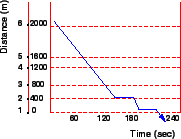 |
Fig. 1 shows the trajectory of a southbound vehicle on this
arterial.
If any offset were changed in Fig. 1 to accommodate the southbound
vehicle(s), then the northbound vehicle or platoon would suffer.
The fact that offsets are interrelated presents one of the most fundamental
problems of signal optimization.
The inspection of a typical cycle (as in Fig. 2) yields the
conclusion that the offsets in two directions add to one cycle length.
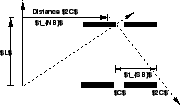
For longer lengths (as in Fig. 3) the offsets might add to two
cycle lengths.
When queue clearances are taken into account, the offsets might add to zero
lengths.
Figure 2:
Offsets on 2 way arterial are not independent- One cycle length
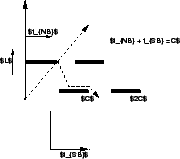 |
Figure 3:
Offsets on 2 way arterial are not independent- Two cycle length
 |
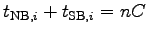
The general expression for the two offsets in a link on a two-way street can be
written as
 |
(1) |
where the offsets are actual offsets, n is an integer and C is the cycle
length.
Any actual offset can be expressed as the desired ideal offset, plus
an error or discrepancy term:
 |
(2) |
where  represents the direction and represents the direction and  represents the link. represents the link.
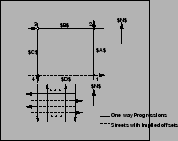
Figure 4:
Closure effect in grid
 |
A one-way street system has a number of advantages, not the least of which is
traffic elimination of left turns against opposing traffic.
The total elimination of constraints imposed by the closure of loops
within the network or grid is not possible.
Fig. 4 highlights the fact that if the cycle length, splits, and
three offsets are specified, the offset in the fourth link is determined and
cannot be independently specified.
Fig. 4 extends this to a grid of one-way streets, in which all of
the north-south streets are independently specified.
The specification of one east-west street then locks in all other
east-west offsets.
The key feature is that an open tree of one-way links can be completely
independently set, and that it is the closing or closure of the open
tree which presents constraints on some links.
|
|
| | |
|
|
|


