| |
| | |
|
If the problem of congestion does not get resolved by signalization the next
set of actions are summarized in two words more space means there is
need of provision of additional lanes or some other facility.
It can be achieved by adding left turn bays / right turn bays, removing
obstructions to through flows by adding more space and free movements
Some non-signal based remedies are given below,
- Two way turn lanes
- Reversible lanes
- Kerb parking prohibition
- Lane marking
On suburban and urban arterials dedication of a central lanes shown in
Fig. 1 for turns in either direction is provided.
This also allows for storage and vehicles to make their maneuvers in two
distinct steps.
Figure 1:
Two way left-turn lane on arterial
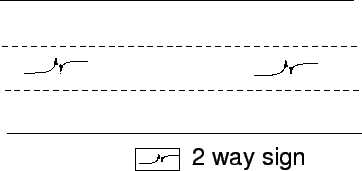 |
Figure 2:
A vehicle leaving arterial in two steps
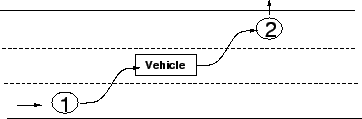 |
Figure 3:
A vehicle entering arterial in two steps
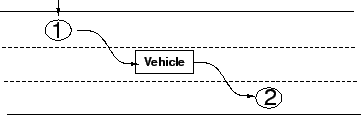 |
Leaving the arterial and entering it is separated into two distinct steps.
Vehicles leaving (Fig. 2) the arterial do not have to
block a moving lane while waiting for a gap in the opposing flow.
Entering vehicles (Fig. 3) do not have to wait for a gap
simultaneously in both directions.
The Figure 1 shown above is the road sign for two way left
turn lane which indicates that the center lane is provided exclusively for two
way left turning traffic.
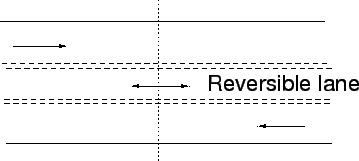
Reversible lanes shown in Figure 8 have great advantage of matching lane
availability to the peak demand.
Lanes are reversible means can be split into various combinations for different
times of day to match the demand.
Figure 4:
Lane marking and associated signal /signs for reversible lane
 |
E.g. eight lanes can be split into 6:2 or 5:3 and so forth if required to match
up for the demand.
It should be noted that some jurisdictions have combined two-way lanes and
reversible lanes on same arterial 'because combination of peak-period
congestion and increased road side development'.
The concerns with reversible lanes and relates to the misuse and lanes by the
driver (particularly the unfamiliar driver), despite the signalization over the
lanes.
High occupancy vehicle (HOV) lanes are designed to help move more people
through congested areas.
HOV lanes offer users a faster, more reliable commute, while also easing
congestion in regular lanes - by moving more people in fewer vehicles.
HOV lanes on provincial highways are reserved for any of the following
passenger vehicles carrying at least two people (often referred to as 2+):
- Car
- Commercial truck less than 6.5 meters long
- Minivan
- Motorcycle
- Taxi or limousine
In addition, vehicles with a special green licence plate (plug-in hybrid
electric or battery electric vehicle)
A bus of any type can use an HOV lane, even without passengers.
This helps buses keep to their schedules and provide reliable, efficient
service.
Emergency vehicles are permitted to use the HOV lanes at all times.
Congestion can be managed by prohibiting the kerb parking.
Kerb parking means on street parallel parking.
If such parking is avoided it implies oblique and right angled parking is also
prohibited and hence provides more space for traffic flow so congestion is
minimized.
Longitudinal lane markings such solid white lines and broken white lines
restricts overtaking maneuver of vehicles which encourages mix through traffic
flow unobstructed resulting in reducing the congestion.
This topic can be read in reference to congestion management by signal based
remedies.
Offset on an arterial are usually set to move vehicles smoothly along the
arterial, as is logical.
Equity offset allows the congested arterial to have its green at upstream
intersection until the vehicle just begin to move , then switch the signal, so
that these vehicles flush out the intersection, but no new vehicles continue to
enter.
This topic can be referred under signal based congestion management remedies.
It is the procedure of allocating the 'available green' in proportion to the
relative demands.
It is sometimes desirable to split green as per demand of various routes to
meet peak hour demands of respective routes.
This topic can be referred as non signal based remedies On provincial highways
HOV lanes are developed by adding a new inside (leftmost) lane to existing
corridors.
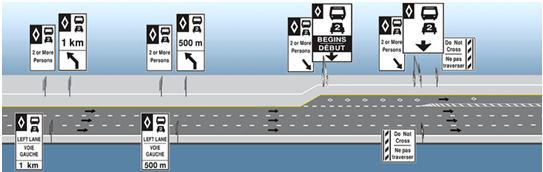
Where the HOV lane begins, signs on the left side of the highway inform
carpools and buses to move left into the new lane.
An overhead sign indicates the beginning of the HOV lane.
In some locations, where a highway on-ramp used to end, the on-ramp lane has
been extended as the new HOV lane.
In this situation, motorists not permitted to use the HOV lane have to exit
that lane before the start of the HOV lane designation.
Overhead signs at 1 kilometre and again at 500 metres before the start of the
HOV lane designation advise drivers to exit the lane.
Overhead signing and closely spaced white broken lines and diamond symbol
pavement markings indicate the beginning of the HOV lane
(Figure 5).
Figure 5:
High Occupancy Vehicle Lane
|
|
|
|
| | |
|
|
|