| |
| | |
|
Signal based remedies for congestion management can be achieved by implementing
following two strategies,
- Metering plans
- Reasonably shorter cycle lengths
It is the congestion management policy for street congestion to limit the
volumes arriving at critical locations.
It uses some control strategies within the congestion networks by storing
vehicles at links defined to be part of system under control.
It should be noted that metering concept does not explicitly minimize delays
and stops but manages queue formation.
There are three types of metering strategies,
- Internal metering:
It is the management policy which makes use of control strategies within the
congested network by influencing the distribution of vehicles arriving at and
departing from critical locations as shown in Fig. 1 Limit
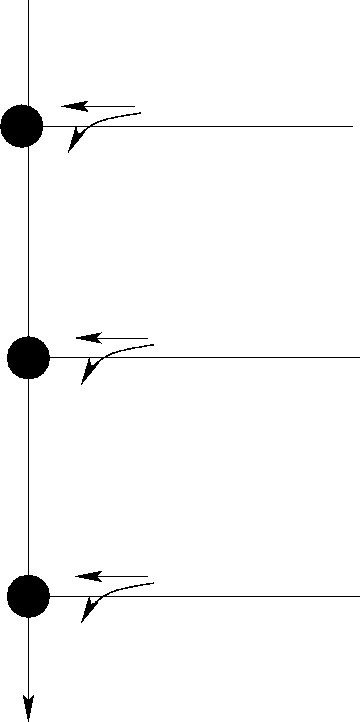
the upstream or downstream blockage by limiting the turn in flows as shown in
Fig. 2.
Figure 1:
g/C is reduced to limit discharge
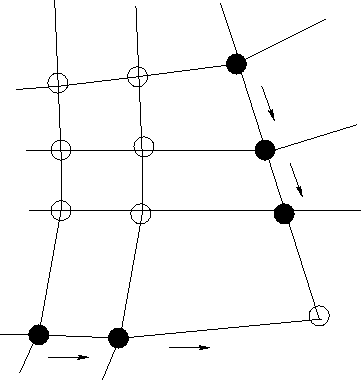 |
Figure 2:
g/C is reduced to preserve through flow
 |
It deals with upstream control by creating moving storage situation on upstream
link.
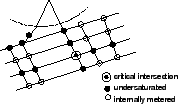
It manages congestion by limiting turn-in flows from cross streets and
preserving arterials for their through flow by metering from face of back up
from outside as shown in Fig. 3
Figure 3:
Internal metering
 |
- External metering:
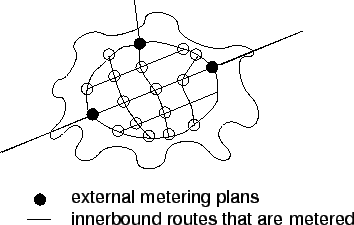
Control of major access points shown in Fig. 4 (e.g.
river crossing, downtown surrounded by water from three sides, a system that
receives limited no. of arterials etc.) so as to limit inflow rates.
It is conceptually convenient because the storage of problem vehicles belongs
to somebody else outside the system.
But while metering it should be noted that metering should not be upto such
extent that other areas.
Figure 4:
External metering
 |
- Release metering:
It uses policy of controlling the release of vehicles from the places where
vehicles are stored such as parking, garages etc. they are stored off-street so
as to reduce their spill-back potential.
This type of metering can be used in shopping centers, mega center, etc. by
lowering the discharge rates of vehicles.
If on any intersection higher cycle time is provided then it will certainly
create problems like increase in queue length and platoon length discharged and
it will lead to increase in blockage of intersection, with substantial adverse
impact on system capacity.
This is particularly when short link lengths are involved.
Length of downstream space should be greater than queue length to store the
vehicles.
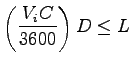
Note that a critical lane flow of Vi nominally discharges Vi*C/3600 vehicles in
a cycle.
If each vehicle requires D meters of storage space, the downstream link would
be
 |
(1) |
where,
 = no. of vehicles per cycle, D= storage space
required for each vehicle, L= available downstream space in m.
(This may be set by some lower value to keep the queue away from the
discharging intersection, or to allow for turn-ins.)
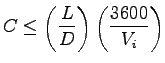
Equation may be re-arranged as, = no. of vehicles per cycle, D= storage space
required for each vehicle, L= available downstream space in m.
(This may be set by some lower value to keep the queue away from the
discharging intersection, or to allow for turn-ins.)
Equation may be re-arranged as,
 |
(2) |
Note that  in this case is the discharge volume per downstream lane, which
may differ from the demand volume, particularly at the fringes of the system
being considered.
Note that only rather high flows (maximum f in this case is the discharge volume per downstream lane, which
may differ from the demand volume, particularly at the fringes of the system
being considered.
Note that only rather high flows (maximum f  800 veh per hour per lane
(vphpl)) and short blocks will create very severe limits on the cycle length.
However, these are just the situations of at most interest for extreme
congestion situations.
An illustrative example to show the requirement of shorter cycle length is
given below.
Flow on an critical lane is 300 veh/h, cycle time is 80 seconds, suppose
storage space required per lane vehicle is 6m as an average and space available
on downstream is 30 m, find whether the space is sufficient and comment on the
result and suggest some remedy if required.
Given: = 300 veh/h,
C = 80 sec, and
L = 30 m.
Vehicles discharged by a critical lane per cycle to be found out and which is
given by, 800 veh per hour per lane
(vphpl)) and short blocks will create very severe limits on the cycle length.
However, these are just the situations of at most interest for extreme
congestion situations.
An illustrative example to show the requirement of shorter cycle length is
given below.
Flow on an critical lane is 300 veh/h, cycle time is 80 seconds, suppose
storage space required per lane vehicle is 6m as an average and space available
on downstream is 30 m, find whether the space is sufficient and comment on the
result and suggest some remedy if required.
Given: = 300 veh/h,
C = 80 sec, and
L = 30 m.
Vehicles discharged by a critical lane per cycle to be found out and which is
given by,
 = 300 * 80/3600
= 60/9
=6.6 veh/cycle.
Therefore, space required for storing these vehicles for cycle time is,
= 6.6 * D,
= 6.6 * 6,
= 39.6 m.
= 300 * 80/3600
= 60/9
=6.6 veh/cycle.
Therefore, space required for storing these vehicles for cycle time is,
= 6.6 * D,
= 6.6 * 6,
= 39.6 m.
 40 m.
So, 40 m 30 m (length of downstream storage i.e. space available),
So length is inadequate.
As the length is fixed the only possible variable is 'cycle time' so we will
reduce the cycle time, let the new cycle time be, 40 seconds instead of 80
seconds.
Space required will be get reduced to half i.e. 20m which is lesser than the
available space i.e. 30m so it is feasible to reduce the cycle length to manage
the congestion. 40 m.
So, 40 m 30 m (length of downstream storage i.e. space available),
So length is inadequate.
As the length is fixed the only possible variable is 'cycle time' so we will
reduce the cycle time, let the new cycle time be, 40 seconds instead of 80
seconds.
Space required will be get reduced to half i.e. 20m which is lesser than the
available space i.e. 30m so it is feasible to reduce the cycle length to manage
the congestion.
|
|
| | |
|
|
|


