| |
| | |
|
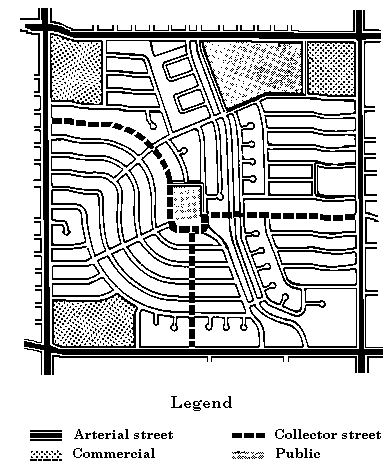
There are three ways of classifying urban streets
- Functional based
- Design based
- Combination of functional and design based
Functional classification is the process by which streets and highways are
grouped into classes, or systems, according to the character of service they
are intended to provide.
Basic to this process is the recognition that individual roads and streets do
not serve travel independently in any major way.
Rather, most travel involves movement through a network of roads.
It becomes necessary then to determine how this travel can be channelized
within the network in a logical and efficient manner.
Functional classification defines the nature of this channelization process by
defining the part that any particular road or street should play in serving the
flow of trips through a highway network.
The four functional systems for urbanized areas are:
- Principal Arterial streets
- Minor Arterial streets
- Collector street
- Local roads
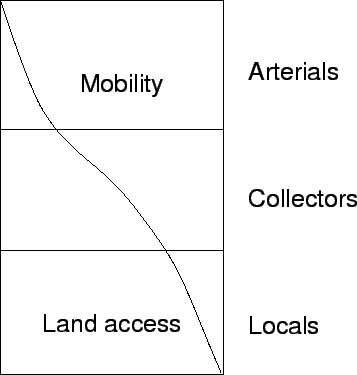
General idea of various streets as per their mobility and land use is shown in
the Fig. 1.
Figure 1:
Relationship of functionally classified systems in service traffic
mobility and land access
 |
Arterial streets are basically meant to carry longer and through traffic.
Function of arterial is to provide access to commercial and residential land
uses.
A downtown street not only carries through traffic but also turning traffics
and it resembles arterials.
As shown in Fig. ![[*]](file:/usr/local/share/lib/latex2html/icons/crossref.png) mobility of principal
arterials is high but land access is very low.
Major arterial serves as principal network for through traffic flow.
This should be connected with principal traffic generations, important rural
highways entering the city.
It should be well coordinated with existing and proposed expressway system for
good distribution and circulation of through traffic and continuity of routes
should be maintained.
In every urban environment there exists a system of streets and highways which
can be identified as unusually significant to the area in which it lies in
terms of the nature and composition of travel it serves.
In smaller urban areas (population under 50,000) these facilities may be very
limited in number and extent and their importance may be primarily derived from
the service provided to travel passing through the area.
In larger urban areas their importance also derives from service to rural
oriented traffic, but equally or even more important, from service for major
movements within these urbanized areas.
The principal arterial system should carry the major portion of trips entering
and leaving the urban area, as well as the majority of through movements
desiring to bypass the central city.
In addition, significant intra-area travels, such as between central business
districts and outlying residential areas between major inner city communities
or between major suburban centers should be served by this system.
Frequently the principal arterial system will carry important intra urban as
well as intercity bus routes.
Finally, this system in small urban and urbanized areas should provide
continuity for all rural arterials which intercept the urban boundary.
The minor arterial street system should interconnect with and augment the urban
principal arterial system and provide service to trips of moderate length at a
somewhat lower level of travel mobility than principal arterials.
This system also distributes travel to geographic areas smaller than those
identified with the higher system.
The minor arterial street system includes all arterials not classified as a
principal and contains facilities that place more emphasis on land access than
the higher system, and offer a lower level of traffic mobility.
Such facilities may carry local bus routes and provide intra-community
continuity, but ideally should not penetrate identifiable neighborhoods.
This system should include urban connections to rural collector roads where
such connections have not been classified as urban principal arterials.
The spacing of minor arterial streets may vary from half to one km in the
central business district to 4 to 5 km in the suburban fringes, but should
normally be not more than 2 km in fully developed areas.
This system of streets includes all distributer and collector streets.
Function of this system is serving between major arterials and local streets to
connect adjacent neighborhood areas placed approximately at half miles
intervals to accommodate local through traffic movements and interconnect local
streets with the major arterial street system.
Unlike arterials their operation is not always dominated by traffic signals.
Local streets are primarily meant for direct access to residential commercial,
industrial or other abutting property.
All through traffics should be discouraged on local streets.
Land access is very high but mobility is very low for local streets. mobility of principal
arterials is high but land access is very low.
Major arterial serves as principal network for through traffic flow.
This should be connected with principal traffic generations, important rural
highways entering the city.
It should be well coordinated with existing and proposed expressway system for
good distribution and circulation of through traffic and continuity of routes
should be maintained.
In every urban environment there exists a system of streets and highways which
can be identified as unusually significant to the area in which it lies in
terms of the nature and composition of travel it serves.
In smaller urban areas (population under 50,000) these facilities may be very
limited in number and extent and their importance may be primarily derived from
the service provided to travel passing through the area.
In larger urban areas their importance also derives from service to rural
oriented traffic, but equally or even more important, from service for major
movements within these urbanized areas.
The principal arterial system should carry the major portion of trips entering
and leaving the urban area, as well as the majority of through movements
desiring to bypass the central city.
In addition, significant intra-area travels, such as between central business
districts and outlying residential areas between major inner city communities
or between major suburban centers should be served by this system.
Frequently the principal arterial system will carry important intra urban as
well as intercity bus routes.
Finally, this system in small urban and urbanized areas should provide
continuity for all rural arterials which intercept the urban boundary.
The minor arterial street system should interconnect with and augment the urban
principal arterial system and provide service to trips of moderate length at a
somewhat lower level of travel mobility than principal arterials.
This system also distributes travel to geographic areas smaller than those
identified with the higher system.
The minor arterial street system includes all arterials not classified as a
principal and contains facilities that place more emphasis on land access than
the higher system, and offer a lower level of traffic mobility.
Such facilities may carry local bus routes and provide intra-community
continuity, but ideally should not penetrate identifiable neighborhoods.
This system should include urban connections to rural collector roads where
such connections have not been classified as urban principal arterials.
The spacing of minor arterial streets may vary from half to one km in the
central business district to 4 to 5 km in the suburban fringes, but should
normally be not more than 2 km in fully developed areas.
This system of streets includes all distributer and collector streets.
Function of this system is serving between major arterials and local streets to
connect adjacent neighborhood areas placed approximately at half miles
intervals to accommodate local through traffic movements and interconnect local
streets with the major arterial street system.
Unlike arterials their operation is not always dominated by traffic signals.
Local streets are primarily meant for direct access to residential commercial,
industrial or other abutting property.
All through traffics should be discouraged on local streets.
Land access is very high but mobility is very low for local streets.
Figure 2:
Schematic illustration of functional classification of rural highway
network
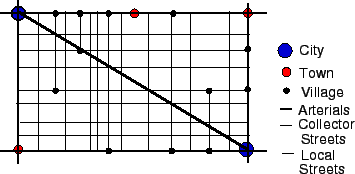 |
Figure 3:
Schematic illustration of a portion of urban street network
|
|
|
|
| | |
|
|
|