Arterial LOS is based on the 'average travel speed' for segment, section or
entire arterial under consideration.
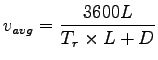
Arterial average travel speed is given by
(1)
where, = arterial or segmental average travel speed (Kmph), L =
arterial or segmental length (Km), = total of the running time per
kilometer on all segments in the arterial or section (seconds), D = total of
the approach delay at all intersections within the defined arterial (seconds).
It is the actual speed in consideration with the additional effect of control
and all stop delays.
It is the measure by which LOS is defined.
This is the last step of determination of LOS.
After calculation of average travel speed we can determine the level of service
of an arterial by using Table 1.
Table 1:
Urban Street LOS by Class and Average Travel Speed
From Table 1 we can find LOS of an arterial.
As free flow speed is 65 kmph by using table 3 we can classify this as Arterial
Class II,
Now we should know average travel speed, to find out LOS.
Delay is determined in problem 1.
Hence D=23.79sec/veh.
As average travel speed is 21.32 kmph we can have LOS as 'E' from
Table 1.


 = arterial or segmental average travel speed (Kmph), L =
arterial or segmental length (Km),
= arterial or segmental average travel speed (Kmph), L =
arterial or segmental length (Km),  = total of the running time per
kilometer on all segments in the arterial or section (seconds), D = total of
the approach delay at all intersections within the defined arterial (seconds).
It is the actual speed in consideration with the additional effect of control
and all stop delays.
It is the measure by which LOS is defined.
= total of the running time per
kilometer on all segments in the arterial or section (seconds), D = total of
the approach delay at all intersections within the defined arterial (seconds).
It is the actual speed in consideration with the additional effect of control
and all stop delays.
It is the measure by which LOS is defined.
 72
72 21
21