|
As a platoon moves downstream from an upstream intersection, the vehicles
disperse i.e., the distance between the vehicles increase which may be due to
the differences in the vehicle speeds, vehicle interactions (lane changing and
merging) and other interferences (parking, pedestrians, etc.,).
This phenomenon is called as Platoon Dispersion.
Dispersion has been found to be a function of the travel time from a signal to a
downstream signal (or other downstream location) and the length of the platoon.
The longer the travel time between signals, the greater the dispersion.
This is intuitively logical since the longer the travel time, the more time
(opportunity) there is for different drivers to deviate from the average travel
time.
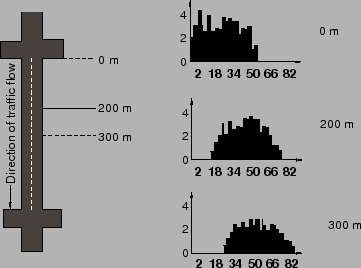
A simple case of Platoon Dispersion is as shown in
Fig. 1.
From the figure, it can be observed that, initially the peak of the platoon is
high and the length of the platoon is comparatively small, but as the platoon
progresses downstream, the peak of the platoon decreases and the length
increases.
Figure 1:
A simple case of Platoon Dispersion
 |
Various traffic engineering software like TRANSYT (Traffic Network Study
Tool) and SCOOT (Split Cycle Offset Optimization Technique) have employed the
phenomenon of Platoon Dispersion for the prediction of Arrival Types.
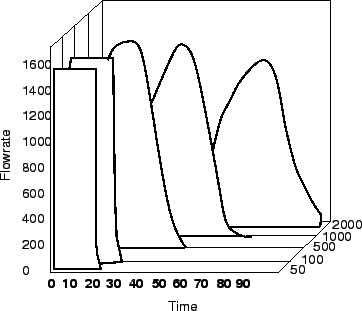
A flow profile obtained from TRANSYT-7F is as shown in the
Fig. 2.
From this figure also, it can be observed that, initially the peak of the
platoon is high and the length of the platoon is small, but as the platoon
progresses downstream, the peak of the platoon decreases and the length
increases.
Figure 2:
A TRANSYT-7F Flow Profile
 |
Platoon dispersion models simulate the dispersion of a traffic stream as it
travels downstream by estimating vehicle arrivals at downstream locations based
on an upstream vehicle departure profile and a desired traffic-stream speed.
There are two kinds of mathematical models describing the dispersion of the
platoon, namely:
- Normal Distribution Model - proposed by Pacey
- Geometric Distribution Model - proposed by Robertson
One of the geometric distribution models is the Robertson's platoon dispersion
model, which has become a virtually universal standard platoon dispersion model
and has been implemented in various traffic simulation software.
Research has already been conducted on the applicability of platoon dispersion
as a reliable traffic movement model in urban street networks.
Most of the research has shown that Robertson's model of platoon dispersion is
reliable, accurate, and robust.
|


