| |
| | |
|
A vehicle Platoon is defined as a group of vehicles travelling together.
A vehicle Platoon is shown in Fig. 1.
The various vehicle platoon characteristics or variables include platoon size,
platoon headway, platoon speed and inter-arrival headway.
Platoon behaviour and distribution patterns could be identified with respect to
these parameters.
The various platoon characteristics are illustrated in
Fig. 2.
Figure 1:
A vehicle Platoon
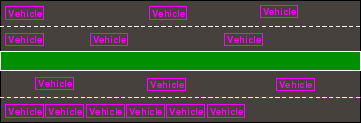 |
Figure 2:
Illustration of Platoon Variables
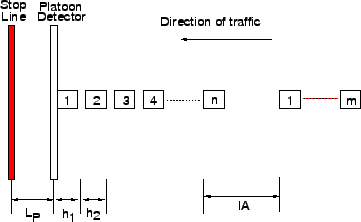 |
- Platoon Size (Np): It is the number of vehicles in a platoon.
- Platoon Headway (hp): It is the average value of headways within
a platoon.
- Platoon Speed (Vp): It is the average speed of all the vehicles
within a platoon.
- Inter-Arrival (IA): It is the headway between the last vehicle
of the preceding platoon and the first vehicle of the following platoon.
Various values of platoon headway and inter-arrival between consecutive platoons
can be used to determine appropriate critical headway for platoon identification
and detection.
Once the critical headway is determined, platoon size and platoon speed can be
detected to calculate the signal timing adjustment to accommodate the
approaching vehicle platoon.
It is of great importance to select a proper value of the critical headway since
a small change in the critical headway will generate tremendous changes in the
resultant platoon characteristics.
Use of a large critical headway will result in a large average platoon size and
require a large detection area in order to detect large vehicle platoons.
Consequently, a large detection area leads to an increase of detector
installation and maintenance costs.
On the other hand, use of a small critical headway will result in a small
average platoon size, but may not provide sufficient vehicle platoon
information.
Therefore, it is desired to find an appropriate critical headway so that
sufficient platoon information can be obtained within a proper detection area.
Research has shown that headways are rarely less than 0.5 seconds or over 10
seconds at different traffic volumes.
Many investigations have been done on finding the effects of critical headways
of 1.2, 1.5, 2.1 and 2.7 seconds on platoon behaviour and these investigations
have shown that a critical headway of 2.1 seconds corresponding to a traffic
volume of 1500 vehicles per hour per lane (vphpl) can be taken for data
collection.
|
|
| | |
|
|
|


