Consider  at each point of at each point of  and and  , and , and
![$ \frac{\partial k}{\partial
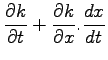
t} + \frac{\partial k}{\partial x}[f(k) + \frac{df}{dk}k] = 0 $](img4.png) in the total
derivative of in the total
derivative of  along a curve which has slope along a curve which has slope
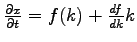 .
ie., Along any curve in .
ie., Along any curve in  , consider , consider  as function of . as function of .
file=qfMacroCharacteristics.eps,width=4cm
Total derivative of will be
At the solution,
 ,
is constant along the curve, ,
is constant along the curve,
 is constant along the curve.
That is, is constant along the curve.
That is,
Note that the solution is to construct some curve  so that:
(a) so that:
(a)
 is the total derivative of along the curve (ie.,
directional derivative) and
(b) slope of the curve is the total derivative of along the curve (ie.,
directional derivative) and
(b) slope of the curve
 .
We know .
Therefore directional derivative along .
We know .
Therefore directional derivative along
That is is constant along the curve or
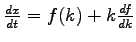 is constant along
curve .
Therefore must be straight line. is constant along
curve .
Therefore must be straight line.
If
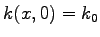 is initial condition is initial condition
This function is plotted below along with a fundamental q-k diagram.
|


![$\displaystyle \frac{\partial k}{\partial t} + \frac{\partial k}{\partial x}\left[f(k) + \frac{df}{dk}k\right]$](img12.png)

![$\displaystyle x_0+\left[\frac{dx}{dt}\right]~t$](img16.png)
![$\displaystyle x_0+\left[f(k) + k.\frac{dt}{dk}\right]t$](img17.png)

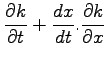
![$\displaystyle \frac{\partial k}{\partial t} + \left[f(k) + k. \frac{df}{dk}\right] \frac{\partial k
}{\partial x}$](img23.png)

![$\displaystyle x(t) = x_0 + \left[f(k) + k.\frac{df}{dk}\right]t$](img26.png)
![$\displaystyle x(t) = x_0 + \left[f(k_0) + k_0. \frac{df}{dk} \bigg\vert _{k=k_0}\right]t$](img28.png)
![\includegraphics[width=7cm]{qfMacroQKdiag1.eps}](img29.png)
![\includegraphics[width=7cm]{qfMacroQKdiag2.eps}](img30.png)
![\includegraphics[width=7cm]{qfMacroQKdiag3.eps}](img31.png)