| |
| | |
|
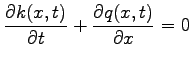
Assuming that the vehicles are flowing from left to right, the continuity
equation can be written as
 |
(1) |
where  denotes the spatial coordinate in the direction of traffic flow, denotes the spatial coordinate in the direction of traffic flow,  is the time,
  is the density and is the density and  denotes the flow.
However, one cannot get two unknowns, namely denotes the flow.
However, one cannot get two unknowns, namely  by and by and  by solving
one equation.
One possible solution is to write two equations from two regimes of the flow,
say before and after a bottleneck.
In this system the flow rate before and after will be same, or by solving
one equation.
One possible solution is to write two equations from two regimes of the flow,
say before and after a bottleneck.
In this system the flow rate before and after will be same, or
 |
(2) |
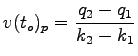
From this the shock wave velocity can be derived as
 |
(3) |
This is normally referred to as Stock's shock wave formula.
An alternate possibility which Lighthill and Whitham adopted in their landmark
study is to assume that the flow rate is determined primarily by the local
density , so that flow can be treated as a function of only density .
Therefore the number of unknown variables will be reduced to one.
Essentially this assumption states that k(x,t) and q (x,t) are not independent
of each other.
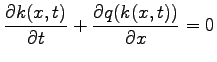
Therefore the continuity equation takes the form
 |
(4) |
However, the functional relationship between flow and density cannot be
calculated from fluid-dynamical theory.
This has to be either taken as a phenomenological relation derived from the
empirical observation or from microscopic theories.
Therefore, the flow rate is a function of the vehicular density k;  .
Thus, the balance equation takes the form .
Thus, the balance equation takes the form
|
(5) |
Now there is only one independent variable in the balance equation, the vehicle
density .
If initial and boundary conditions are known, this can be solved.
Solution to LWR models are kinematic waves moving with velocity
 |
(6) |
This velocity  is positive when the flow rate increases with density, and
it is negative when the flow rate decreases with density.
In some cases, this function may shift from one regime to the other, and then a
shock is said to be formed.
This shock wave propagate at the velocity is positive when the flow rate increases with density, and
it is negative when the flow rate decreases with density.
In some cases, this function may shift from one regime to the other, and then a
shock is said to be formed.
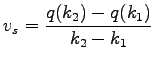
This shock wave propagate at the velocity
 |
(7) |
where  and and  are the flow rates corresponding to the upstream
density are the flow rates corresponding to the upstream
density  and downstream density and downstream density  of the shock wave.
Unlike Stock's shock wave formula there is only one variable here. of the shock wave.
Unlike Stock's shock wave formula there is only one variable here.
|
|
| | |
|
|
|


