| |
| | |
|
The analytical solution, popularly called as LWR Model, is obtained by defining
the relationship between the fundamental dependant traffic flow variable (
 ) to the independent variable ( ) to the independent variable (
 ).
However, the solution to the continuity equation needs one more equation: by
assuming ).
However, the solution to the continuity equation needs one more equation: by
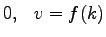
assuming  , ie., , ie.,  .
Therefore: .
Therefore:
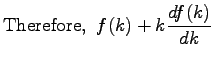
Therefore,
Continuity equation can be written as
where  could be any function relating density and speed.
Eg: Assuming the Greenshield's linear model: could be any function relating density and speed.
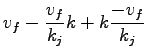
Eg: Assuming the Greenshield's linear model:
Therefore,
![$\displaystyle \frac{\partial k}{\partial t}+ \frac{\partial k}{\partial x}\left[v_f - 2\frac{v_f}{k_j}k\right]= 0$](img23.png) |
(1) |
The equation 1 is first order quasi-linear, hyperbolic,
partial differential equation (a special kind of wave equation).
|
|
| | |
|
|
|


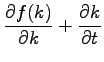
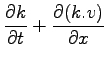
![$\displaystyle \frac{\partial k}{\partial t} + \frac{\partial [k.f(k)]}{\partial x}$](img10.png)
![$\displaystyle \frac{\partial [k.f(k)]}{\partial x}$](img12.png)
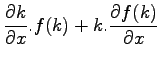
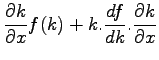
![$\displaystyle \frac{\partial k}{\partial x} \left[f(k) + k. \frac{df}{dk}\right]$](img15.png)
![$\displaystyle \frac{\partial k}{\partial t} + \frac{\partial k}{\partial x}\left[f(k) +k.
\frac{df}{dk}\right] = 0$](img16.png)