On the contrary, a positively charged Y would exert strong electron withdrawing inductive effect thereby increasing the acidity of the β-protons 1 and 2 . The effect is somewhat nullified by the electron donating inductive effect of the methyl group for protons marked 1 but not for protons marked 2 . Thus, now the reaction proceeds through a T.S having a “carbanion character”.
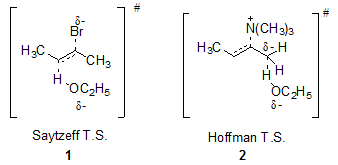
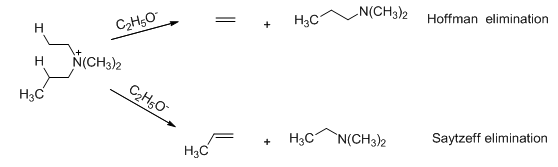
Another example Hoffman elimination vs Saytzeff elimination is that, where there is more than one potential RN(CH3)2 leaving groups, the elimination occurs in such a fashion to yield the least substituted alkene.
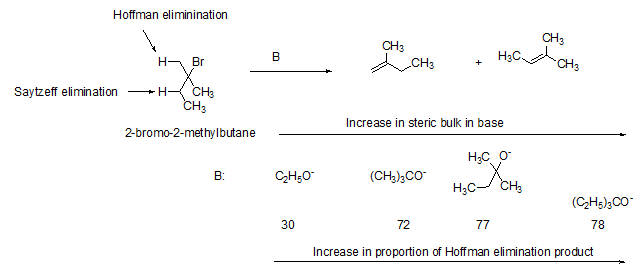
Increase of steric crowding in the T.S of E2 elimination also favours the formation of Hoffman product over Saytzeff product progressively. This crowding can be either in alkyl halide (R groups), leaving groups (Y) and attacking base (B:). Thus in the E2 elimination of 2-bromo-2-methylbutane, with the increase in steric bulk in the attacking base, the proportion of Hoffman elimination product increases.
It must be considered that the aliphatic nucleophilic substitution and elimination reaction of alkyl halides have a striking similarities in terms of the reactants involved since a nucleophile can also act as a base. Thus, in a given reaction elimination vs substitution ratio can be of importance. There may be five considerations in determining the elimination to substitution ratio.
- In terms of reactant structure, branching in the reactant structure, especially leading to increase in steric bulk at carbon next to leaving group leads to increase in E2/SN2 ratios. This is reflected in the fact that 3° alkyl halides seldom undergo substitution.
- In terms of the attacking species, a species which can act as a strong base favours elimination over substitution. This is also aided by the fact that strong bases are seldom good nucleophiles.
- In terms of the leaving group, the correlation between elimination vs substitution (E2 vs SN2) is not very clear. However, it seems that a better leaving group slightly favours the E2/SN2 ratio. On the other hand positive charged leaving groups greatly enhance the rate of elimination reactions.
- In terms of solvent polarity, increase in solvent polarity leads to decrease in elimination vs substitution for second order reactions. For the first order reactions substitution is usually favoured in all solvents. E1 reactions are favoured in polar solvents which do not act as nucleophiles.
- On increasing the temperature, elimination reactions are usually favoured over substitution reactions. This is on account of the fact that the activation energies of eliminations are higher than substitution reactions.
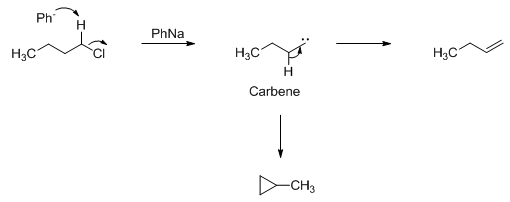
A relatively less examples have been observed for 1,1-eliminations i.e.; elimination reactions in which both the leaving group(Y) and the proton abstracted by the base were on the same carbon. They tend to be favoured by powerful electron withdrawing leaving groups and by strong bases. In examples of this type of eliminations, there are instances of formation of carbene intermediates. Thus, when 1-chlorobutane is treated with phenylsodium, the corresponding 1,1-elimination product is obtained. The formation of a carbene intermediate in this case is inferred from the side product 1-methylcyclopropane
Grignard reagents, a very important class of organometallic reagents are prepared by the reaction of alkyl halides with magnesium metal.
