In some cases, the nucleophile may have more than one reactive center through which it may attack the substrate. Such nucleophiles are called ambident nucleophiles. Obviously the regioselectivity becomes a key noticeable fact in the operation of ambident nucleophiles. Cyanide ion (CN-) provides an ideal example of this kind. In a reaction with an alkyl halide, it may attack through the carbon or through nitrogen leading to alkyl cyanides and alkyl isocyanides, respectively. The preference whether cyanide will attack seems to depend on the HSAB principle. In a SN1 reaction a carbocation (hard acid) with a “naked” charge is involved, so cyanide attacks through its hard centre nitrogen leading to the formation of alkyl isocyanide. If however, the reaction proceeds through SN2 then the attack is through the softer carbon centre leading to alkyl cyanides.

If the reaction of alkyl halide with sodium hydroxide is carried out in an alcoholic solution instead of aqueous medium, elimination occurs to give an alkene as a product. This is a new class of reactions known as elimination reactions . Since several nucleophiles are also potential bases, thus there is a continuous competition between aliphatic nucleophilic substitution and elimination reactions. The factor which decides in whose favour the scales will tilt seems to be a combination of solvent, strength of the nucleophile/base and structure of substrate.
The class of reactions known as elimination reactions are also an important reaction of alkyl halides. These reactions evidently lead to elimination of two moieties from an alkyl halide leading to formation of carbon-carbon multiple bonds. The most common type of elimination involves 1,2-elimination where the groups are lost from adjacent carbon atoms. Three different pathways have been envisaged for 1,2-elimination reactions.
1. E2 (Elimination Bimolecular) pathway: Here both the leaving groups are detached from the alkyl halide at the same time with simultaneous formation of the new bond i.e. the H-C and C-Y (Y = leaving group) are broken simultaneously while the new C=C is formed. This pathway does not involve any intermediate but passes only through a 5 center transition state (T.S). It may be represented as:

The rate law for this pathway both the bond forming and bond breaking may be represented as:
Rate = k[ RY][B:]
The formation of 3-isopropyl-6-methylcyclohex-1-ene from menthyl chloride follows E2 pathway:
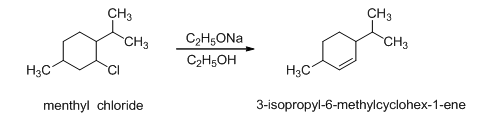
2. E1(Elimination Unimolecular) pathway: Here, the substrate undergoes elimination of the leaving group (Y) to form a carbocation which then undergoes elimination of a proton to give the alkene as the product. This pathway therefore involves the formation of an intermediate from which the proton is abstracted by the base. This may be represented as:

In this case only the formation of the carbocation is involved in the slow rate limiting step and, thus, its rate law is represented as:
Rate = k[RY]
For example, see the solvolysis of 2-bromo-2-methylbutane by ethanol .
