3. E1cB (Elimination Unimolecular Conjugate Base) pathway: Like E1, this pathway also involves two steps. In this pathway, the base abstracts a proton from the substrate to generate a carbanion which then undergoes elimination of the leaving group (Y) to give the corresponding alkene as product. This mechanism is relatively rare and operates only in substrates where the carbanion is stabilized by electron withdrawing groups. This may be represented as:

In this case, the elimination of the leaving group (Y) occurs in the slow rate limiting step and, thus, the rate law may be expressed as:
Rate = k[RY][B:]
The elimination of HF from 2,2-dichloro-1,1,1-trifluoroethane serves as an example for the operation of E1cB pathway.

In relation to stereochemistry of the elimination reactions, E2 pathway is stereospecific in nature leading to elimination in an anti -periplanar conformation where the hydrogen abstracted by the base and the leaving group are anti to each other. This can be inferred from the fact that elimination of HBr from (1R ,2S )-1,2-dibromo-1,2-diphenylethane gave exclusively (E)-2-bromostillbene while any of the optically active enantiomeric dibromides provided the (Z )-alkene as the only product (Scheme 4).
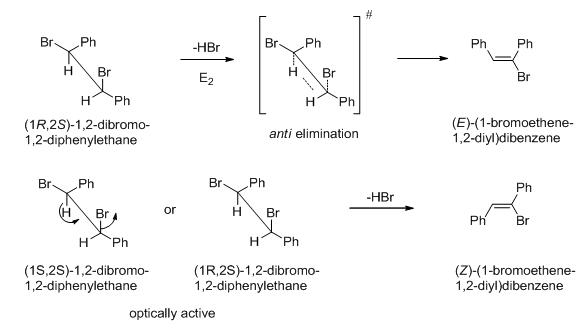
Scheme 4
The reason for this observation lies in the fact that the anti -periplanar (staggered) conformation is more stable than the syn -periplanar (eclipsed) conformation and thus it allows the elimination to take place in a state of low energy. Furthermore, in this conformation, the attacking base B:, and the departing group (Y-) are as far from each other as possible in the T.S.
As both the E1 and E1cB pathways involve planar carbocation and carbanion intermediates respectively, so there is no element of stereoselectivity involved in these pathways.
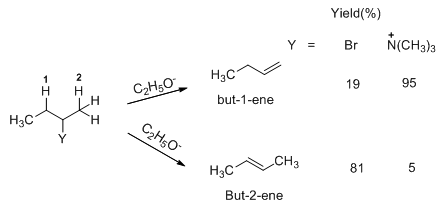
In a case of comparison of the products formed by E2 elimination of 2-bromobutane and N,N,N -trimethylbutan-2-aminium ion, it is found that the former yields but-2-ene as the major product while the latter yields but-1-ene as the major product. The prediction which alkene will be formed depends on the nature of the leaving group. There are two specific rules in this regard known as Saytzeff rule and Hoffman rule. Hoffman rule states that the alkene having least alkyl substituents on the double bond will predominate while Saytzeff rule states that the alkene having more alkyl substituents on the double bond will predominate. Though these two rules appear contradictory in nature but both are true as is shown in the above example (but-1-ene is Hoffman product while but-2-ene is Saytzeff product). Saytzeff elimination seems to occur when Y is neutral in nature. In these reactions, the reaction is believed to proceed via a T.S which does possess a considerable degree of “alkene character” which leads the stabilizing effect of the alkyl groups to play a role in lowering the energy of the T.S.