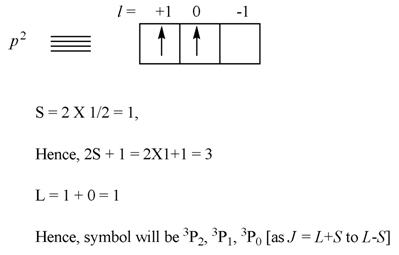
The Aufbau principle:
This principle states that atoms are built up by successive addition of protons at nucleus and electron at the extra-nuclear part. The newly added electrons will occupy the available orbital of lowest energy before filling higher energy state.
The Pauli Exclusion principle:
According to this theory, no two electrons in an atom will process same set of four quantum numbers.
Hund's rules:
This rule is applied for the determination of the electronic ground state.
(i) For a given electronic configuration the term with maximum multiplicity (3 S + 1; S = spin angular momentum) will have the lowest energy.
(ii) For a given multiplicity the term with the largest L (angular momentum quantum number) value will occupy the lowest energy.
(iii) For a given term, in an atom with less than half - filled outer most electronic configuration, the lowest energy configuration will be with the lowest value of J (total angular momentum quantum number, J = L ± S ). For more than half - filled outer most electronic configuration, the lowest energy configuration will be with the highest value of J.
* Terms are in capital letter as they represent energy states of electronic configuration.
Example:
2 S +1 L J
S = No. of unpaired electron(s)×1/2. L stands as, L = 0 is S , L =1 is P , L = 2 is D , L =3 is F , L = 4 is G , and so on. J is the vector sum of L and S. It varies as, J = L + S , L + S -1, L + S -2, .... L - S