5.6.2 Asymmetric Aziridination
Aziridines are versatile building blocks in organic synthesis. Considerable progress has been made in the area of asymmetric aziridination employing copper based systems. Mn(porphyrin) and Mn-salen complexes have been shown as effective catalysts for this reaction. The reactions proceed via active nitrenoid species and most of the methods use a hypervalent iodine reagent such as PhI=NTs as nitrenoid source. The deprotection of N-sulfonyl groups require harsh reaction conditions, development of new methods has thus been focused without protecting group or with a readily removable group. In this context, the use of azide compounds as nitrogen source has been recently demonstrated.
Ru-salen is found to be effective catalyst for the aziridination of alkenes with TsN3 at room temperature with excellent enantioselectivity (Scheme 12). p -Nitro and o -nitrobenzenesulfonyl azide and 2-(trimethylsilyl)ethanesulfonyl azide (SESN3) are also effective for this reaction affording the aziridine with high enantioselectivity. Furthermore, less nucleophilic α, β -unsaturated esters proceed aziridination with high enantioselectivity.
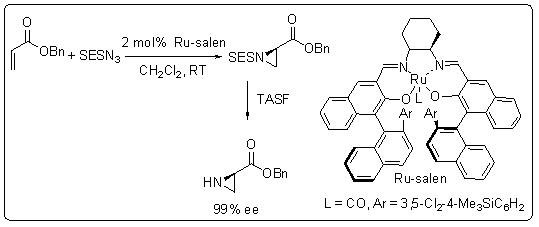
Scheme 12
An aminimide that is generated by deprotonation of the corresponding aminimine undergoes aziridination of chalcone via conjugate addition and ring closure by N-N bond cleavage. For example, O-mesitylenesulfonylhydroxylamine proceeds reaction in the presence of (+)-Troger base and CsOH∙.H2O with moderate enantioselectivity (Scheme 13). Soon after the use of quiniclidine for the reaction of O -(diphenylphosphinyl)hydroxylamine with chalcone is shown with 56% ee (Scheme 14).
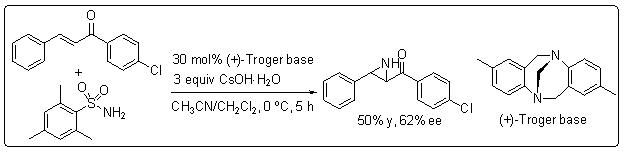
Scheme 13
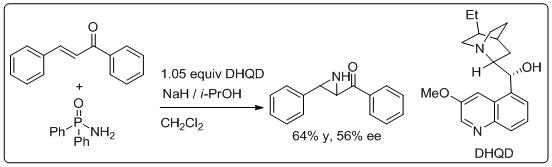
Scheme 14