The key issue is the regioselectivity of the reaction. Replacement of sulfonamide in chloramine-T with alkyl carbamates like BnO2CNH2 , EtO2CNH2, and t-BuO2CNH2 or amides greatly improves the reaction scope of the substrate and selectivity up to 99% ee and 80% yield. Also carbamate product could be easily converted into free amino alcohol. t -Butyl carbamate is superior to ethyl carbamate in terms of yield, enantioselectivity, and ease of removal of the N -protecting group.
Nitrogen source 2-trimethylsilylethyl N -chloro- N -sodiocarbamate (TeoCNClNa) could be synthesized by reacting NaOH and t -BuOCl with 2-(trimethylsilyl)ethyl carbamate, which can be prepared by successively adding carbonyl diimidazole and ammonia to 2-trimethylsilylethanol in benzene (Scheme 9-10). The TeoC group can be cleaved by fluoride under very mild conditions, yielding the free amino alcohol with high enantiomeric purity.
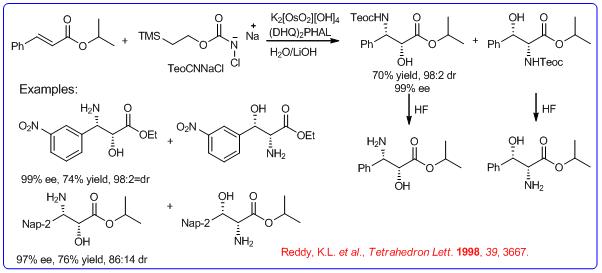
Scheme 9. Aminohydroxylation using TeoCNNaCl as the Nitrogen Source
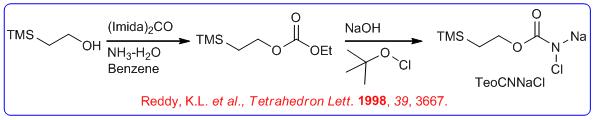
Scheme 10. Synthesis of TeoCNNaCl
The mechanism of the reaction is shown in Scheme 11. The Os(VI) azaglycolate is reoxidized by the N -chloroamide substrate and releases the target product after hydrolysis. The reoxidized metallacycle undergoes a second cycloaddition leading to an Os(VI) bis(azaglycolate). Conducting the reaction in an aqueous medium under more dilute conditions favors the hydrolysis.
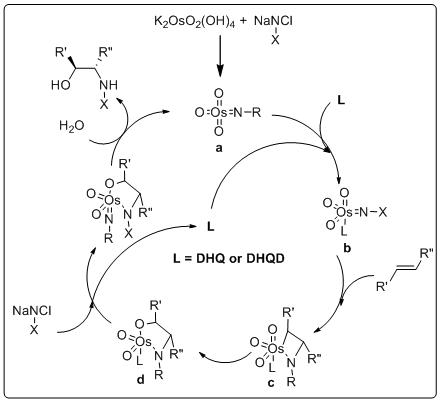
Scheme 11. Mechanism of Sharpless Aminodihydroxylation