5.6 Dihydroxylation, Aminohydroxylation and Aziridination Reactions
5.6.1 Dihydroxylation Reaction
In 1980, the first attempt for enantioselective cis -dihydroxylation of alkenes with osmium tetroxide was appeared. Subsequent continuous efforts led to improve the reaction yield and enantioselectivity in the presence of osmium-cinchona alkaloid complexes (Scheme 1). The reactions can be performed at ambient conditions in liquid-liquid biphase system having water and t-BuOH employing secondary oxidant such as K3Fe(CN)6 to afford the target 1,2- cis diols with high enantioselectivity. Please see Module I, Reagents and Organic Reactions, for the mechanism.
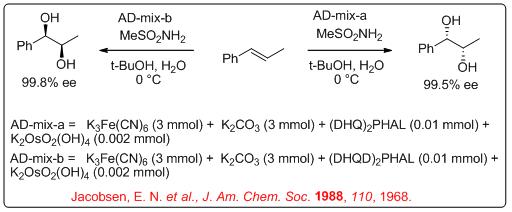
Scheme 1
K3Fe(CN)6 is used as a oxidant to reoxidize the Os(VI) after each catalytic cycle. Since OsO4 is volatile and toxic, the osmium is usually added as K2OsO2 (OH)4, which forms OsO4 in the reaction mixture. K2CO3 and methanesulfonamide (MeSO2 NH2) are used as additive to enhance the rate of the reaction. Scheme 2 summarizes some of the successful cinchona alkaloid based ligands for the asymmetric dihydroxylation reactions. The approach of hydroxyl group is directed to either the top face or the bottom face of the alkene which depends on the nature of the ligands, DHQD or DHQ, are used.
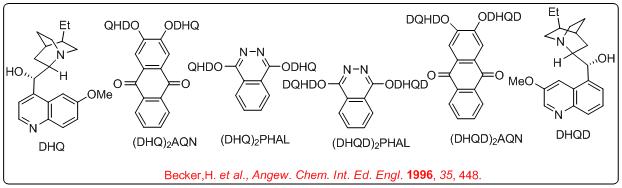
Scheme 2
In parallel to the above described catalytic processes, the use of optically active bidentate 1,2-diamine based ligand L has been demonstrated in place of alkaloid as a chiral source for the asymmetric dihydroxylation of alkenes using OsO4 (Scheme 3). The reactions of a series of alkenes can be accomplished with good to excellent yield and enantioselectivity.
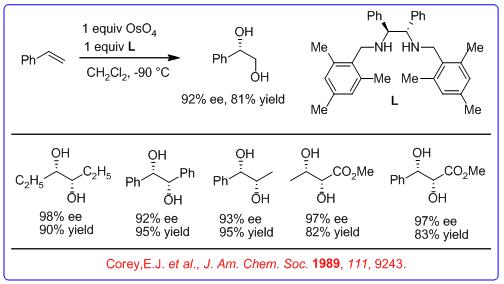
Scheme 3