4.2.2.2 Ytterbium(II) Iodide (YbI2)
YbI2 has been used for the reductive cyclization of halo ketones to afford five, six and seven membered rings (Scheme 25). The reactions show better diastereoselectivity compared to that with SmI2 reactions.
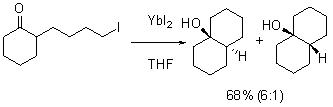
Scheme 25
4.2.2.3 Ytterbium(III) Trifluoromethanesulfonate (Yb(OSO2 CF3 )3)
Organoyetterbium triflates derived from organolithium and Yb(OTf)3 exhibits greater diastereoselectivity in carbonyl addition to chiral aldehydes and ketones. For example, 2-methylcyclohexanone with the methylytterbium reagent gives a mixture of diastereoisomers in 98:2, resulting from the favoured equatorial attack of the bulky organolanthanide reagent (Scheme 26).
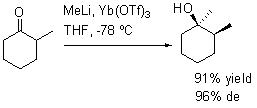
Scheme 26
Yf(OTf)3 has been extensively used as Lewis acid catalyst for aldol reactions (Scheme 27). Unlike other Lewis acid catalysts, water does not interfere with the reactions when Yb(OTf)3 is employed. In addition, molecules with free hydroxyl and nitrogen functionalities are compatible and do not coordinate with Yb(OTf)3 . Furthermore, the catalyst may be recovered from the aqueous solution and recycled.

Scheme 27