·
4.2.1.2 Samarium(III) Chloride (SmCl3)
SmCl3 is air and moisture sensitive and the reactions are to be performed under inert atmosphere.
Carbon-Carbon Bond Formation
Sm(II) species generated by the electrochemical reduction of SmCl3 promotes the coupling of carbonyl compounds to give cyclopropane diols (Scheme 5). The process is, however, limited to carbonyls having aromatic functionality.
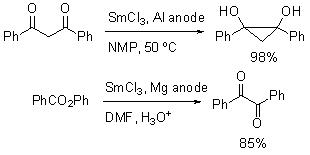
Scheme 5
Using catalytic amount of SmCl3 , aldol reaction of silyl enol ether with aldehydes can be performed at ambient temperature (Scheme 6). These reaction conditions are also effective for cyanohydrins synthesis from aldehydes and TMSCN.

Scheme 6
1,2-Allylation of α,β -unsaturated carbonyl compounds can be accomplished using SmCl3 , n-BuLi and tetraallylstannane at ambient temperature (Scheme 7).
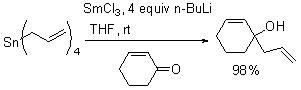
Scheme 7
Epoxide Ring Opening and Protecting Group Removal
SmCl3 catalyzes the reaction of epoxide with thiol nucleophiles to give thioalcohol in high yield (Scheme 8). The process is regio- and stereoselective and takes place in shorter reaction time as compared to the other Lewis acid catalyzed systems.
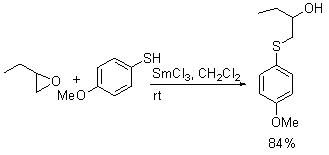
Scheme 8
SmCl3 can be used for the cleavage of acetals to give carbonyl compounds (Scheme 9). The transformation of acetals to aldehydes is slower than that to ketones. Thus, the present method can be employed for the chemoselective removal of acetal protecting groups. Acid-sensitive functional groups such as t-butyldimethylsilyl ethers and methoxy methyl ethers are inert to these reaction conditions.
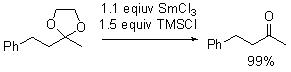
Scheme 9