4.2.2.1 Ytterbium (Yb)
Yb can be used for Birch type of reduction of aromatic and alkenic compounds, coupling of aldehydes and ketones to give pinacol and formation of organoytterbium reagents that can react with ketones, epoxides and nitriles to afford functionalized compounds.
Reduction Reactions
Solutions of Yb in ammonia have properties similar to that of alkali metal-ammonia solutions and can reduce aromatic and alkenic compounds like Birch reduction (Scheme 20).
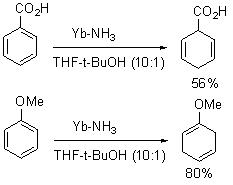
Scheme 20
Carbon-Carbon Bond Formation
Yb promotes pinacolic coupling of diaryl ketones with aldehydes and ketones (Scheme 21). However, it is limited due to the requirement of one of the pinacolic partiner must contain aromatic functionality.

Scheme 21
Organoytterbium complex derived from Yb and aryl ketone can be reacted with electrophiles such as ketones, epoxides, nitriles and carbon dioxide to afford the corresponding pinacol, 1,3-diol, α -hydroxy ketone, and α -hydroxy carboxylic acid, respectively (Scheme 22).

Scheme 22
4.2.2.2 Ytterbium(II) Chloride (YbCl2)
The reductive dimerization of α,β -unsaturated ketones and hydroperfluoralkylation of alkenes have accomplished in the presence of YbCl2.For example, chalcone undergoes dimerization to give cyclopentanols (Scheme 23). The reaction involves a single electron-transfer to the conjugated system, followed by addition of the resulting enolate radical to the starting material. The reaction shows significant diastereoselectivity.

Scheme 23
Addition of perfluoroalkyl iodide to alkenes containing ester, ether, alcohol, and phosphonate proceeds in the presence of YbCl2 in good yield (Scheme 24).

Scheme 24