Samarium and ytterbium compounds find wide applications in organic synthesis. This section covers most of the important processes.
4.2.1.1 Samarium (Sm)
Samarium in combination with dihalomethane is used to iodomethylate ketones and aldehydes. These reaction conditions are also effective for the transformation of esters and α -haloketones to cyclopropanols, and directed cyclopropanation of allylic alcohols.
Iodomethylation of Ketones and Aldehydes
A wide variety of aldehydes and ketones can be converted into iodohydrins using samarium and diiodomethane in excellent yield (Scheme 1). Under these conditions, hindered ketones do not react, while α,β -unsaturated carbonyl compounds afford the desired products in moderate yield.
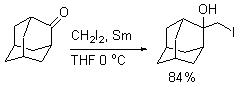
Scheme 1
Cyclopropanation
Using the above conditions, esters and α -halo ketones can be converted into cyclopropanols, thereby affording a one-carbon homologation (Scheme 2). The reactions occur via Simmons-Smith-type cyclopropanation of the samarium enolate.
Directed cyclopropanation of allylic alcohols can be efficiently accomplished using Sm(Hg) and dihalomethane under mild conditions (Scheme 2). Many functional groups such as isolated alkenes, homoallylic alcohols are inert under these conditions. Compared to Simmons-Smith and related reagents, the present protocol performs the cyclopropanation stereospecifically. For example, cyclopropanation of geraniol can be accomplished with complete stereospecificity in excellent yield (Scheme 3).
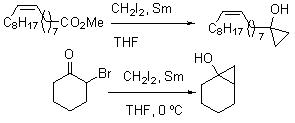
Scheme 2
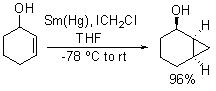
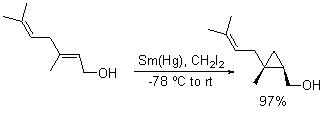
Scheme 3
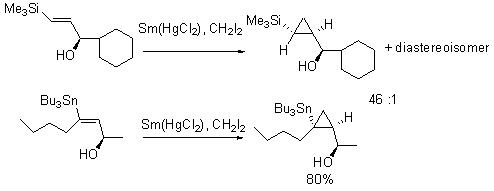
Scheme 4
Alkenes containing tin or silicon substituents also react with excellent diastereoselectivity under similar reaction conditions, affording highly functionalized cyclopropanes (Scheme 4).