However, when carbonylation is carried out in presence of a small amount of water, migration of third alkyl group from boron to carbon is inhibited and resulting compound is dialkylketone and not trialkylcarbinol (Scheme 7).
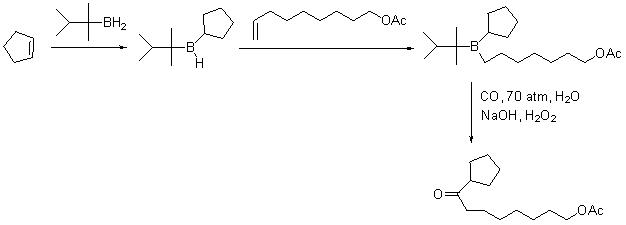 |
Scheme 7 |
The carbonylation sequence can be modified to afford aldehydes as well as primary alcohols. For example, 4-vinylcyclohexene with 9-BBN gives the usual organoborane that can undergo carbonylation in the presence of lithium trimethoxyaluminum hydride [LiAlH(OMe)3] to provide an a-boranyl alkoxyaluminate. The latter could be converted into alcohol by cleavage using hydroxide or can be oxidized to aldehyde using buffered hydrogen peroxide (Scheme 8).
 |
Scheme 8 |
3.5.2.3 Conjugate Addition
Trialkylboranes undergo conjugate addition with α,β-unsaturated aldehydes and ketones. In this reaction, alkyl group of the borane undergoes 1,4-addition and boron is tranfered to the oxygen, giving a boron enolate that on hydrolysis gives the product (Scheme 9).
 |
Scheme 9 |