Borane (BH3) exists as the gaseous diborane (B2H6). It is commercially available in the form of complexes generally with THF, Et2O and Me2S. It can also be prepared from the reaction of NaBH4 with BF3. Organoboranes can be prepared rapidly by the addition reaction of borane to alkenes and alkynes.
3.5.1 Hydroboration of Alkenes
Boranes react with alkenes to form alkylboranes that could be oxidized in the presence of alkaline hydrogen peroxide to give alcohols. The result is a cis, anti-Markownikoff addition of water. The C-B bond is converted into a C-OH with retention of stereochemistry.
 |
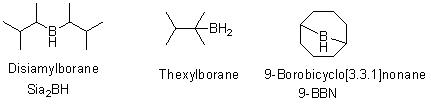
With hindered alkenes, it is more difficult to add three alkenes to borane. This becomes the basis for the development of unique borane derivatives. For examples, see:
 |
Proposed Mechanism
The hydroboration and oxidation reactions are regioselective and proceed by cis addition of hydrogen and boron, probably via a four-center transition state (Scheme 1).
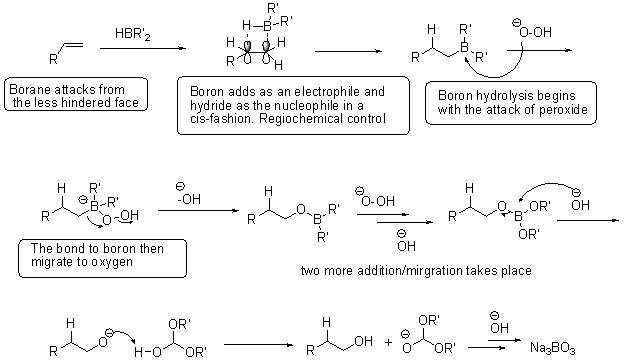 |
Scheme 1 |