On heating, alkylboranes proceed isomerization to yield products that have the boron atom at the least hindered position of the alkyl chain (Scheme 4).
 |
Scheme 4 |
3.5.2.2 Coupling
Alkylboranes on treatment with basic silver nitrate lead to coupling of the alkyl groups (Scheme 5). The reaction probably proceeds via an alkyl silver intermediate and affords a useful tool for the carbon-carbon bond formation.
 |
Scheme 5 |
3.5.2.3 Carbonylation: Formation of Alcohols, Aldehydes and Ketones
Alkylboranes can be transformed into alcohols, aldehydes and ketones on reaction with CO followed by oxidation. These reactions require high pressure and high temperature. For example, 1,5,9-cyclododecatriene proceeds reaction with B2H6 to give tricyclic borane that could be converted into tricylic alcohol by carbonylation and oxidation (Scheme 6).
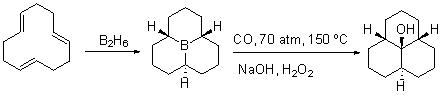 |
Scheme 6 |
Mechanism
The reaction involves an intramolecular migration of alkyl groups from boron to the carbon atom of CO.
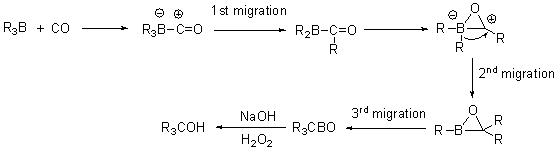 |