The organomagnesium halides (RMgX), known as Grignard reagents, are useful synthetic intermediates in organic chemistry for carbon-carbon bond formation. They may be regarded as polar compounds and are sources of nuleophilic carbanions.
The organomagnesium halides are prepared by the action of magnesium on alkyl, aryl or vinyl halides in either dry ether or THF, and the resultant solution is used for the subsequent reactions. In case the reaction is sluggish, small amount of iodine is added to initiate the reaction. The rate of the formation of the organomagnesium halides can be significantly accelerated by sonication.
3.1.1.1 Reactions with Carbonyl Compounds
Being nucleophilic in nature, the organomagnesium halides undergo 1,2-addition to the carbonyl
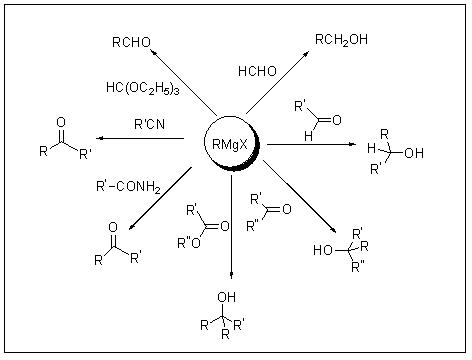 |
Scheme 1 |
group of aldehydes, ketones, esters, anhydrides, acid chlorides and amides (Sheme 1). In these reactions, the alkyl, aryl or vinyl group having carbanionic character become attached to the carbonyl carbon and the magnesium halide to the oxygen of the carbonyl group to give a complex (addition product). These addition products on decomposition with proton source give the corresponding alcohols (Scheme 2).
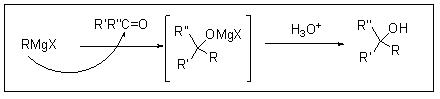 |
Scheme 2 |
If the carbonyl group is attached with a leaving group (i.e., if R1= OR, Cl) then the tetrahedral adduct can break down to regenerate a C=O group that undergoes a fast second addition step (Scheme 3).
 |
Scheme 3 |